
pCloud or Internxt for Lifetime Storage?
The Great Migration
Disclosure: This article contains affiliate links. If you purchase through them, BAIZAAR may earn a commission at no extra cost to you. We only recommend tools we genuinely rate highly ourselves.
Welcome to The Great Migration: the accelerating exodus from public cloud giants to proper private alternatives like pCloud and Internxt, where lifetime deals mean you actually own your storage rather than renting it from data vampires indefinitely.
Ever find yourself staring at a bloated Google Drive folder stuffed with tax docs, family photos, client contracts, and that budget spreadsheet from 2018 you swear you’ll fill out fully one day. Then the news hits. Another Big Tech privacy breach and/or plain disregard for your privacy is highlighted again, for many existing paying users. Suddenly your entire digital life feels uncomfortably exposed, and the quiet thought you’ve been batting away for months gets very loud rather quick.
This isn’t manufactured hype, and it’s not just paranoia (though a healthy dose of that never hurt anyone). Reddit threads are stacking up, X posts are multiplying, and the evidence from regulatory bodies, courtrooms, and breach reports is damning enough to make anyone reconsider hitting “sync” on a mainstream cloud app. We’ve dug into both pCloud and Internxt equally, 50/50, no favourites, covering lifetime deals, annual plans, rclone compatibility, honest limitations, and the reasons to flock BigTech’s grasp that matter most to us in 2026. The migration is already happening. The only question is which destination suits your particular flavour of privacy-first.
- What You'll Actually Learn Here
- The Great Migration: Real People, Real Receipts
- Big Tech Betrayals: The Receipts Are Ugly
- pCloud Unpacked: Swiss Reliability, Lifetime Freedom
- Internxt Deep Dive: Spain's Privacy-First Challenger
- pCloud or Internxt for lifetime storage comparison
- A Quick Word on Proton Drive
- Your Great Migration – Data Action Plan
- pCloud or Internxt for lifetime storage – Frequently Asked Questions (fAQ)
- pCloud or Internxt for Lifetime Storage? BAIZAAR's Bottom Line
What You’ll Actually Learn Here
- Whether pCloud or Internxt is better for lifetime cloud storage in 2026
- How they compare on privacy architecture, pricing, rclone support, and family plans
- Why the case against Big Tech cloud storage is built on courtroom verdicts, not vibes
- A practical migration action plan you can follow this weekend.
The Great Migration: Real People, Real Receipts
People aren’t just talking about switching. They’re doing it, posting receipts, and dragging their frustrations with Big Tech into the open.
On Reddit’s r/cloudstorage, a thread comparing lifetime cloud storage providers in 2026 consistently surfaces pCloud and Internxt as the front-runners, with users citing “no monthly drain” and “actual ownership” as the decisive factors. Then there’s the “99 Year Lifetime Test,” where a redditor stress-tested whether lifetime truly meant lifetime across four providers. Both pCloud and Internxt cleared the bar on contractual and operational grounds.
Over on r/internxt, the community is vocal about one specific gap. Families are losing out compared to pCloud purely because Internxt lacks a dedicated lifetime family plan option. Legitimate observation. Worth filing away before you commit. A six-month real-world Internxt review on the same subreddit flagged that while the web interface is clean, desktop sync reliability needs attention. Honest feedback. The kind worth knowing before a lifetime decision.
In r/cybersecurity, the language gets blunter. Privacy-conscious users are ditching mainstream platforms not on a whim but out of genuine concern about AI training on file contents, government data requests, and the creeping normalisation of being scanned without consent. The consensus is fairly unambiguous: if you’re still on Google Drive without a secondary encrypted layer, you’re a statistic waiting to happen.
A pCloud-commissioned European survey gave this grassroots sentiment a data backbone. 82% of European respondents distrust US cloud giants in the post-COVID era, with 71% planning to increase cloud usage but demanding markedly better privacy as the non-negotiable condition. Clinical psychology tells us that fear of loss hits harder than excitement of gain. Right now, people feel genuinely exposed, and that’s an entirely rational response.
Big Tech Betrayals: The Receipts Are Ugly
The case against Big Tech cloud storage isn’t built on vibes. It’s built on verdicts.
Google was hit with a USD 425 million jury verdict for tracking 98 million users even after they’d explicitly opted out of Web and App Activity. The tracking happened covertly via third-party apps including Uber and Instagram, routing data back to Google despite clear privacy promises. Google later defeated a bid for billions more in penalties, not because they were innocent, but on procedural grounds. Cold comfort if your files are sitting in Drive right now.
Dropbox has accumulated a grim track record. A significant data breach exposed customer credentials, with REvil-linked actors later sentenced in connection with related attacks. Russian authorities also fined Dropbox 2 million rubles for failing to comply with data localisation requirements, a regulatory signal that the platform is struggling to satisfy even basic national-level compliance, let alone the expectations of individual users storing sensitive personal documents.
OneDrive and Microsoft don’t escape scrutiny either. One widely-shared case involved a user losing access to 30 years of photos and work documents following an automated account suspension. No warning. No human contact. Just 18 ignored support forms and a wall of boilerplate emails. GDPR fines of up to 4% of global annual revenue are now a genuine deterrent forcing re-evaluation across the industry, and Europe’s scepticism of US cloud services is hardening into actual policy at pace.
Your legal documents, client contracts, family media, financial records, and private ID are considerably safer somewhere that doesn’t serve a surveillance-adjacent business model. That’s not a slogan. It’s the logical conclusion of what the courtroom evidence keeps showing us.
pCloud Unpacked: Swiss Reliability, Lifetime Freedom
pCloud launched in Switzerland in 2013 and has remained scandal-free for over a decade. In cloud storage terms, that’s practically a geological epoch.
Lifetime plans sit at 500GB for around USD 199, 2TB for USD 399, and up to 10TB for USD 1,199, with prices that regularly dip during promotional windows. Annual subscriptions start at approximately USD 49.99 for 500GB for those not ready to go lifetime just yet.
The standout technical feature is the virtual drive mount. Your cloud storage appears as a local disk on your system, which is genuinely transformative for media professionals and anyone managing large creative folders who would rather not wait for a full local sync. Block-level sync keeps transfers fast. File versioning spans 15 to 365 days depending on your plan, a useful safety net for anyone who has ever accidentally overwritten something critical. Which is all of us, at some point.
On privacy, the default setup uses standard server-side encryption, fine for bulk everyday storage. For sensitive material, ID documents, financial records, legal files, pCloud’s Crypto add-on activates true zero-knowledge AES-256 encryption at the folder level, with keys that never leave your device. The Crypto add-on runs approximately USD 49.99/year or is available as a one-time lifetime purchase. It also pairs cleanly with Cryptomator at no extra cost if you prefer an open-source encryption layer.
rclone compatibility is native and well-documented. Configure via OAuth, select “pcloud” as the storage type, and you can migrate from Google Drive, Dropbox, or even shift between pCloud’s US and EU data centre regions without touching a file manager. Linux users get full GUI and CLI clients, virtual drive mounts work with NAS setups including Synology, and the Dropbox migration in particular is consistently praised as drag-and-drop simple.
pCLoud limitations to factor in
- Crypto costs extra whether you pay annually or for life, it’s not bundled
- US and Luxembourg data centre locations (rather than purely Swiss) raise eyebrows in strict EU compliance conversations
- No distributed storage architecture, it’s centralised in the traditional sense
- Family lifetime plan options are more established here than with competitors, which matters if that’s your use case
The payoff point: a 2TB lifetime plan at USD 399 pays for itself against Google One or Dropbox subscriptions in approximately three years. After that, you’re simply ahead.
Internxt Deep Dive: Spain’s Privacy-First Challenger
Internxt takes a fundamentally different architectural approach. Rather than centralised servers (however well-encrypted), Internxt fragments and distributes your encrypted file pieces across a global network of nodes. Hack one node and you get confetti, not files. For users whose threat model extends beyond “probably fine,” that distinction matters enormously.
Spain-based and GDPR-native, Internxt publishes its full source code publicly, inviting independent security audits rather than asking you to take their word for it. Zero-knowledge AES-256 encryption is built in by default. No add-on required. No additional cost. No configuration needed. That’s a genuinely different proposition to pCloud’s tiered approach.
Lifetime plans currently sit at approximately USD 200 for 1TB, USD 400 for 3TB, and USD 600 for the 5TB Ultimate tier. Annual plans start from around USD 26.40 for 1TB, meaningfully cheaper per TB than pCloud’s entry subscription price and a compelling value proposition for privacy-conscious buyers not quite ready to commit to lifetime.
rclone support arrived as a major feature update and works natively via S3-compatible and WebDAV protocols. Configure via rclone config, select S3-compatible storage, plug in your API keys from the Internxt dashboard, and bulk data moves across to Internxt’s distributed infrastructure without fanfare. Confirmed working reliably in 2026.
The open-source transparency extends to the lifetime plan terms, which are clear: no arbitrary suspensions for legitimate use, and recovery processes exist for edge cases. Reddit’s pre-purchase question threads consistently report confidence in the terms, with existing lifetime holders validating the real-world experience rather than just the marketing copy.
On family and team plans, Internxt’s lifetime family option is an active area of community demand. The r/internxt thread on this is explicit: lost conversions to pCloud are happening precisely because the lifetime family tier isn’t yet matching pCloud’s maturity here. Standard family plans do exist and support password-protected sharing, but teams should factor this gap in before signing.
Internxt’s limitations to factor in
- No block-level sync and no file versioning at the core tier
- Maximum storage cap is 5TB versus pCloud’s 10TB
- Desktop app polish, while improving, trails pCloud’s more mature client experience
- The “switched from pCloud to Internxt” thread on Reddit is worth reading in full before you decide — the transition is largely positive, but connectivity edge cases are real
The payoff point: 1TB lifetime plan at approximately USD 200 versus USD 26.40/year annually means breakeven arrives well inside eight years. The privacy architecture means you’re getting a qualitatively different product, though. Not just a cheaper one.
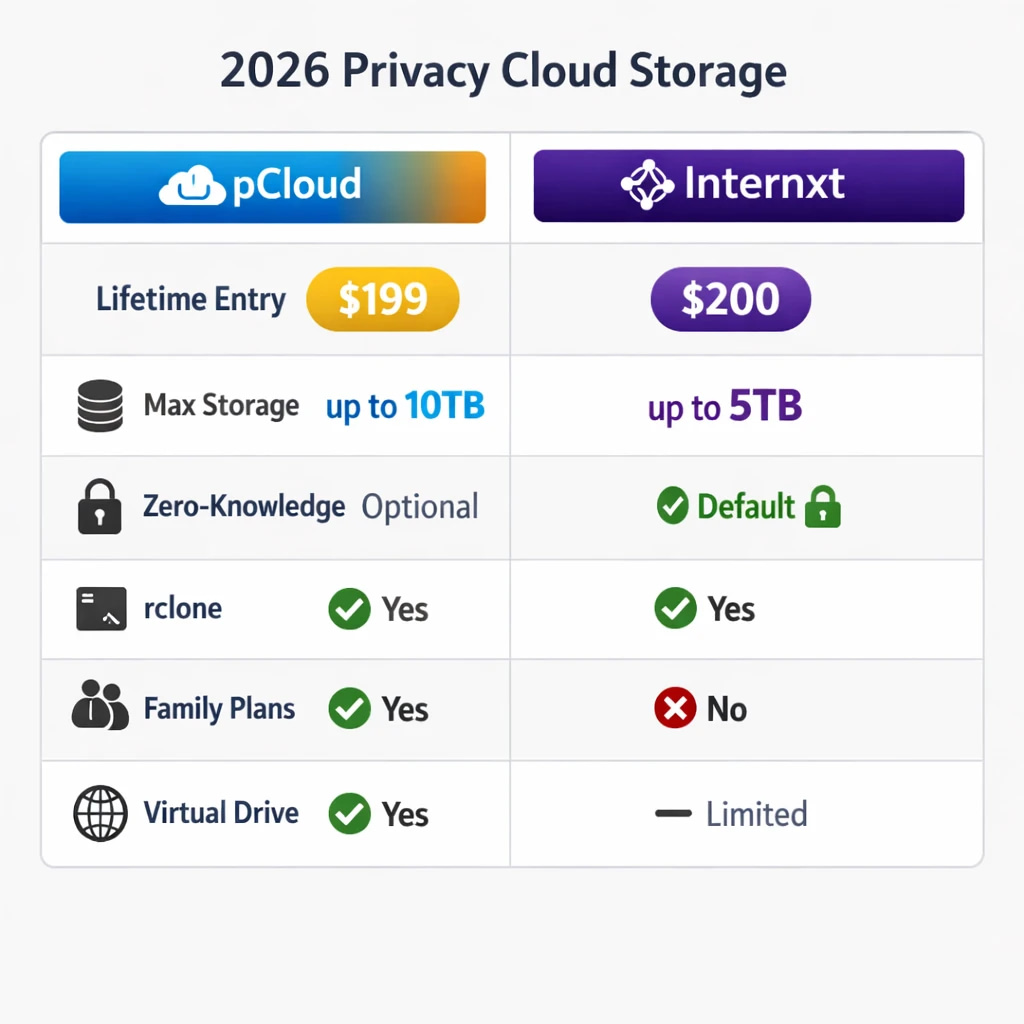
pCloud or Internxt for lifetime storage comparison
Both products deliver something Big Tech fundamentally cannot: a private cloud you genuinely control, backed by client-side encryption no third party can break without your key. The philosophical overlap is total. The architectural and usability divergence is where your actual decision lives.
| Features & Pricing | pCloud | Internxt |
|---|---|---|
| Lifetime Entry | 500GB / ~USD 199 | 1TB / ~USD 200 |
| Max Lifetime | 10TB / USD 1,199 | 5TB / USD 600 |
| Zero-Knowledge | Optional Crypto add-on (paid) | Built-in by default |
| Architecture | Centralised (Swiss/EU servers) | Distributed global nodes |
| rclone | Native OAuth | Native S3 / WebDAV |
| Virtual Drive | Yes, mounts as local disk | No |
| File Versioning | 15 to 365 days | Not included |
| Linux / NAS | Full CLI and GUI | API keys / WebDAV |
| Annual Start | USD 49.99 / 500GB | USD 26.40 / 1TB |
| Family Lifetime | Established options | Developing, active demand |
| Subscription Payoff | Around Year 3 | Year 6 to 8, better per-TB |
| Open Source | No | Yes |
pCloud edges out on usability, platform maturity, media workflows, and family plan options. Internxt takes the lead on raw privacy architecture, open-source transparency, per-TB value, and zero-knowledge by default. Neither is objectively superior. They are built for slightly different versions of the same privacy-first user.
A Quick Word on Proton Drive
In every serious conversation about private cloud storage, Proton Drive surfaces eventually. Rightly so.
For users migrating from Big Tech, Proton Drive serves a distinct but complementary role: Swiss zero-knowledge by default, seamlessly integrated with Proton Mail and Proton VPN, available from approximately £0.90/month for 200GB. The practical approach, as explored in detail in our Proton Drive vs pCloud deep-dive, is a tiered strategy: Proton Drive for the genuinely sensitive vault items (passports, financial records, legal documents), paired with pCloud or Internxt lifetime storage for the heavier bulk lifting.
Proton doesn’t currently offer lifetime plans, so it’s not a direct competitor in this comparison. But if your migration strategy involves multiple layers of privacy rather than a single solution, it absolutely belongs in the stack conversation.
Your Great Migration – Data Action Plan
The practical steps are considerably less intimidating than the decision itself.
1. Audit your files first. Separate everything into two categories: genuinely sensitive (ID, financials, legal, client data, family documents) and general bulk storage (media libraries, creative projects, archives). That split tells you whether you need zero-knowledge by default (Internxt’s territory) or flexible encryption on demand (pCloud’s Crypto model).
2. Test before you commit. pCloud offers a 14-day trial and Internxt offers a 30-day refund window. Use both. Stress-test sync speeds, rclone compatibility against your existing setup, and client apps on your actual devices before you make a lifetime decision.
3. Use rclone for the heavy lifting. Whether you’re migrating from Google Drive, Dropbox, or OneDrive, rclone’s native support for both pCloud (OAuth) and Internxt (S3/WebDAV) means bulk transfers don’t require manual downloading and re-uploading. Set it up once, let it run overnight, and verify the other side in the morning.
4. Layer if it makes sense. A pCloud or Internxt lifetime plan for the bulk, Proton Drive for the vault. This combination covers every privacy tier without over-engineering your setup.
pCloud or Internxt for lifetime storage – Frequently Asked Questions (fAQ)
Is pCloud or Internxt better for privacy?
Internxt has the stronger privacy architecture by design, using distributed node storage with zero-knowledge encryption built in at no extra cost. pCloud offers excellent privacy but requires adding the Crypto add-on (paid separately) for true zero-knowledge protection. If privacy is the primary concern, Internxt wins by architecture. If usability and platform maturity matter equally, pCloud is the stronger daily driver.
Are pCloud or Internxt for lifetime storage safe to trust?
Both providers have been independently stress-tested on this. Reddit’s “99 Year Lifetime Test” evaluated both platforms on contractual and operational grounds, and both passed. pCloud has operated for over a decade without major incident. Internxt publishes open-source code that external security researchers can audit independently. Neither guarantee is unconditional, but both are considerably more trustworthy than month-to-month subscriptions from companies whose business model involves monetising your data.
Does pCloud or Internxt support rclone in 2026?
Both do. pCloud uses native OAuth configuration via rclone config. Internxt uses S3-compatible and WebDAV protocols, also configured via rclone config. Both are confirmed working reliably in 2026 for bulk data migrations from Google Drive, Dropbox, and OneDrive.
Which is better for families?
pCloud currently wins on family plan maturity. Internxt has a lifetime family plan in active community demand but not yet at pCloud’s level of development. If a shared lifetime family account is a hard requirement, pCloud is the cleaner choice right now.
What is the cheapest way to try Internxt or pCloud before going lifetime?
Internxt’s annual plan starts at USD 26.40 for 1TB. pCloud’s annual plan starts at approximately USD 49.99 for 500GB. Both offer trial or refund windows, so you can test extensively before committing to lifetime pricing. That’s the sensible sequence.
pCloud or Internxt for Lifetime Storage? BAIZAAR’s Bottom Line
The migration is already happening. The Reddit threads, the regulatory fines, the courtroom verdicts, and the breach reports aren’t abstract warnings. They’re the accumulated consequences of trusting private data to organisations whose business models weren’t built around protecting it.
Both pCloud and Internxt offer what Big Tech doesn’t: storage you own, encryption you control, and a pricing model that stops extracting rent the moment you decide to pay once and be done. The only remaining question is which flavour of privacy-first fits your life?
Your files deserve better than a company that got fined USD 425 million for reading them anyway…
Get a pCloud lifetime plan and actually own your storage – stop renting your digital life from people who profit from scanning it.
Explore Internxt’s lifetime plans if distributed architecture and zero-knowledge encryption by default are non-negotiable for you.
Migrate before the next fine lands on someone else’s doorstep. Their data looked remarkably similar to yours.
Last updated: April 2026
Article Citations:
- Reuters — Google USD 425 million privacy verdict
Reuters Google Verdict - Huntress / ForkLog — Dropbox data breach
Huntress Dropbox Breach - BAIZAAR — Stop Using Google Drive
baizaar.tools Privacy Cloud Guide - pCloud Official Pricing Page
pCloud Pricing Official - Internxt Blog – Lifetime Cloud Storage: Best Providers, Pricing & Security Comparison 2026
Internxt Lifetime Comparison