Encrypted Video
Conferencing in 2026:
Why Proton Meet Changes Everything
avoiding Commercial Video Meeting surveillance
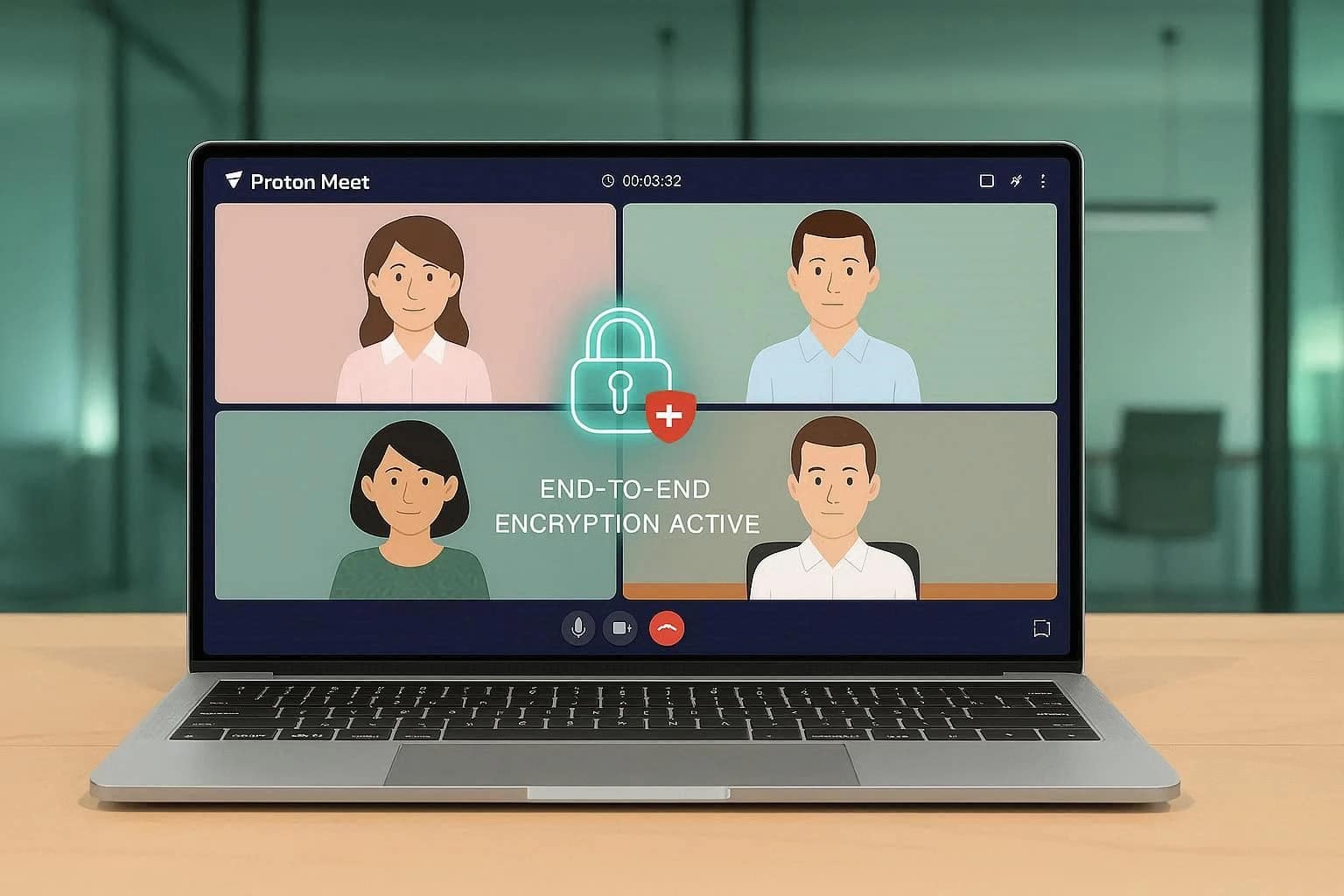
Your video calls are not private. Zoom, Google Meet, and Microsoft Teams can all access your audio, video, and chat data. And in 2026, they are feeding it into AI models whether you notice or not. Proton Meet is the first mainstream-grade encrypted video conferencing tool that applies true end-to-end encryption to every call, so not even Proton itself can listen in. It is free for up to 50 attendees. The Meet Professional plan starts at $7.99 USD / approx. £6.29 / €7.39 per user per month, and the Workspace bundle brings that down further. If you handle sensitive conversations. Client calls, medical consultations, executive strategy. This is the tool you should be using. Try Proton Meet free
- Your Video Calls Are Not Private. Here Is Why That Matters in 2026.
- What Is Encrypted Video Conferencing, Exactly?
- Proton Meet Features: What Actually Solves Real Problems
- Proton Meet vs. Zoom vs. Google Meet vs. Microsoft Teams
- Who Should Be Using Proton Meet Right Now?
- How to Start Your First Encrypted Video Call on Proton Meet
- Proton Meet FAQ
- Is Proton Meet free?
- Is Proton Meet end-to-end encrypted?
- Can I use Proton Meet without a Proton account?
- How does Proton Meet compare to Zoom for privacy?
- Where is Proton Meet's data hosted?
- Final Verdict: Is Proton Meet Worth It?
This article contains affiliate links. If you purchase through our links, BAIZAAR earns a small commission at no extra cost to you. We only recommend tools we actively use and trust. Read our full disclosure.
Your Video Calls Are Not Private. Here Is Why That Matters in 2026.
Video calls became infrastructure. Not a feature, not a preference. Actual infrastructure, like email and cloud storage, that most of us cannot really operate without. Client pitches, medical consultations, board strategy, school check-ins. We treat these calls like closed-door meetings.
They are not.
Mainstream platforms like Zoom, Google Meet, and Microsoft Teams all use transport-layer encryption. That phrase sounds reassuring until you understand what it actually means. Your call is encrypted while it travels across the internet, but decrypted on the provider’s servers before being re-sent to other participants. At that midpoint, the provider has full access to your audio streams, video feeds, screen shares, and chat. A government subpoena, a rogue employee, or a server-level data breach is the only barrier between your private conversation and the outside world.
That barrier is getting thinner. As Big Tech pivots hard into AI, meeting data has become training material. Depending on shifting privacy policies, fragments of your audio, your screen shares, your chat logs could be processed to improve AI models. You would not hand a transcript of your board meeting to a stranger. You may already be doing exactly that, call by call, without realising it.
Then there is the jurisdictional problem. The US CLOUD Act can compel any US-owned platform to hand over stored data, regardless of where that data physically lives. If your organisation is subject to GDPR, the UK Data Protection Act, or any equivalent regime, using a US-domiciled conferencing tool introduces a compliance conflict that no contractual language fully resolves. This is not theoretical. It is operational exposure sitting inside your daily workflow.
Over 100 million people have already reached this conclusion and moved to Proton’s ecosystem. Mail, VPN, Drive, Pass. For exactly these reasons. Proton Meet is the logical next step.
What Is Encrypted Video Conferencing, Exactly?
Short answer: it means the provider genuinely cannot access your call. Every component. Audio, video, screen shares, chat. Encrypted on your device and can only be decrypted on the recipient’s device. The servers in between handle only ciphertext. There is nothing to read, nothing to subpoena, nothing to breach.
This is end-to-end encryption (E2EE). It is fundamentally different from what Zoom and Google advertise. Transport-layer encryption, which most platforms offer, protects your data in transit. Then it is decrypted at the server level so the platform can process, relay, and record it. E2EE removes the server from the trust equation entirely.
Proton Meet is built on Messaging Layer Security (MLS), an open-source encryption protocol that has been independently audited and peer-reviewed by external cryptographers. Open source matters here because you are not being asked to trust a marketing claim. You can inspect the protocol yourself. Independent cryptographers already have. This is verifiable trust, which is a genuinely different category of thing from brand trust.
This distinction carries real weight for anyone handling privileged information. Legal professionals bound by attorney-client privilege. Healthcare providers navigating patient confidentiality under GDPR or the UK’s Caldicott principles. Executives discussing M&A. Journalists protecting sources. Additionally, for anyone who has started noticing the privacy trade-offs that most people never stop to clock. The slow, quiet erosion that happens when convenience wins every time.
Proton Meet Features: What Actually Solves Real Problems
Privacy tools have historically asked users to accept a worse product in exchange for better security. Proton Meet is a meaningful exception to that pattern. Here is what it actually offers, framed around the problems each feature addresses.
End-to-End Encryption on Every Call Layer, Not Just Some of Them
Every component of a Proton Meet call is encrypted with MLS. Not just audio. Not just video. Screen shares and in-meeting chat messages are encrypted too. Most competitors that offer any form of E2EE apply it selectively. Zoom’s optional E2EE mode, for example, does not cover all call types and requires everyone to be on the desktop app. Proton closes that gap without requiring you to configure anything.
No Account Required to Join
One of the most common reasons privacy tools fail in practice: adoption friction. If the person you are calling needs to create an account first, the conversation defaults back to WhatsApp, Zoom, or whatever is already installed. Proton Meet eliminates this completely. Generate a link, share it, and anyone can join from a browser. No Proton account. No sign-in. No plugin. The security does not depend on everyone having opted in beforehand, which is the only realistic way to actually use a privacy tool at scale.
Calendar Integration That Fits Existing Workflows
Proton Meet connects to Proton Calendar, Google Calendar, and Microsoft Calendar. Booking pages generate Meet links automatically. Appointments include one-click join. For teams already embedded in existing workflows, this removes the “switching cost” argument entirely. And that argument, in our experience, is the one that kills adoption faster than any feature gap.
A Free Tier That Is Genuinely Usable
Up to 50 attendees. Up to 60 minutes. Full end-to-end encryption. No feature-gating on the security model itself. For solo professionals, freelancers, and small teams, the free tier is sufficient. Not a teaser designed to frustrate you into upgrading.
Meet Professional: Worth It When Calls Run Your Day
For teams that live in video calls, the Meet Professional plan starts at $7.99 USD / approx. £6.29 / €7.39 per user per month. That unlocks extended meeting durations, higher attendee capacity, and additional collaboration features. It also comes bundled inside Proton Workspace Standard, which starts at $6.99 USD / approx. £5.49 / €6.49 per user per month and includes Mail, Calendar, VPN, Drive, and Pass alongside Meet. If your team runs more than a handful of calls per week, the Workspace bundle at $6.99 USD / £5.49 / €6.49 per user per month is the more sensible entry point.
We have already reviewed Proton’s encrypted email offering in depth. Meet follows the same design philosophy: serious security, no usability tax. Whether that extends to feature parity with Zoom over time remains to be seen. But the foundation is solid.
Proton Meet vs. Zoom vs. Google Meet vs. Microsoft Teams
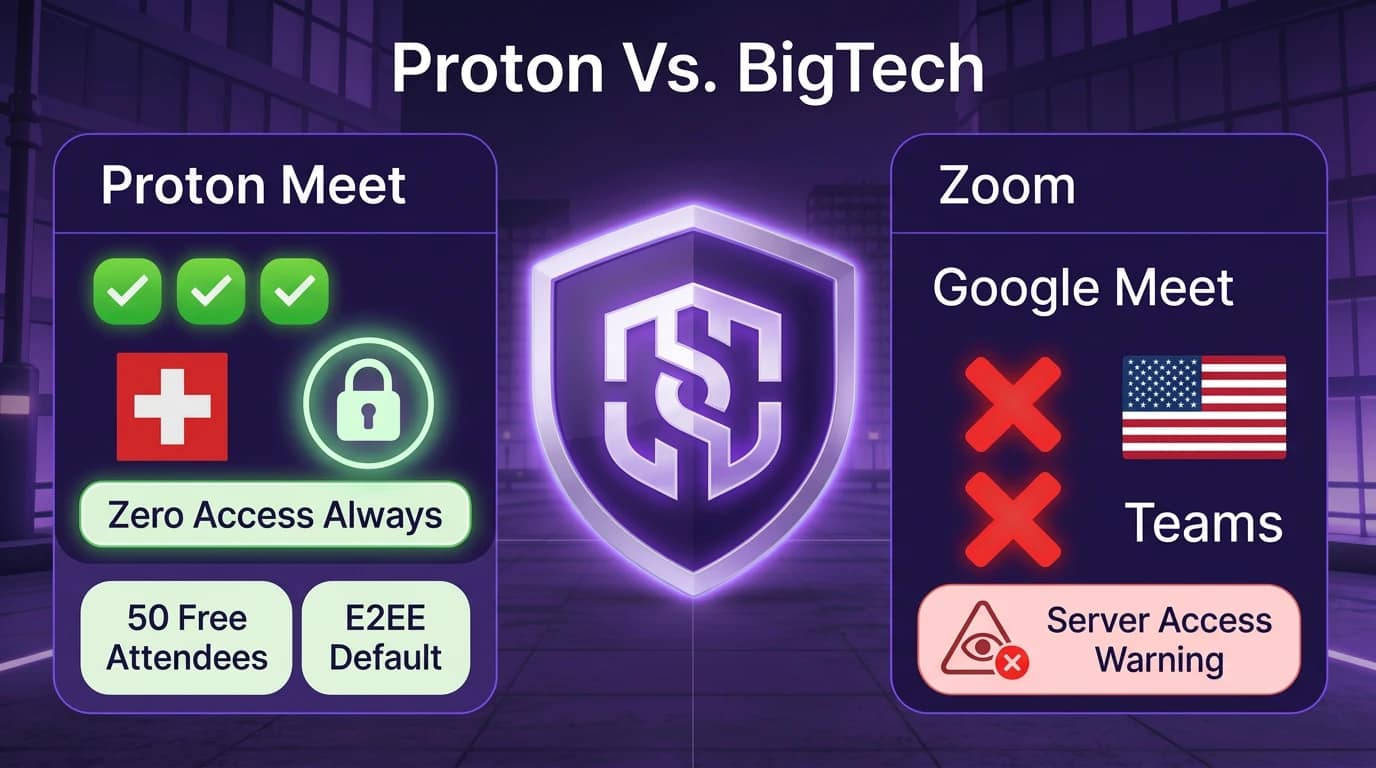
| Feature | Proton Meet | Zoom | Google Meet | MS Teams |
|---|---|---|---|---|
| End-to-end encryption (all calls) | Always on | Optional, limited | Transit only | Transit only |
| Provider can access call data | No (zero access) | Yes | Yes | Yes |
| AI training on call data | Never | Policy-dependent | Policy-dependent | Policy-dependent |
| Free tier (max attendees) | 50 | 100 | 100 | 100 |
| Free tier (max duration) | 60 min | 40 min | 60 min | 60 min |
| No account required to join | Yes | Yes | No | No |
| Jurisdiction | Switzerland | USA | USA | USA |
| Open-source encryption protocol | Yes (MLS) | No | No | No |
The table covers the features side. The architecture difference runs deeper. Zoom, Google, and Microsoft compete on capabilities: breakout rooms, AI summaries, transcription, virtual backgrounds. Proton competes on trust model. Swiss jurisdiction means Proton operates under Swiss data protection law, which is among the strictest in the world and sits entirely outside the reach of the US CLOUD Act. Combined with E2EE and an open-source, audited protocol, this creates a fundamentally different relationship between the user and the provider.
You can verify this yourself. Proton’s published transparency report details every legal request they receive and how they respond. In most cases, there is simply nothing to hand over. Zero-access encryption means Proton does not have it. That is not a marketing claim. That is a structural guarantee built into how the software works.
Who Should Be Using Proton Meet Right Now?
Not everyone needs encrypted video conferencing in the same way. But more people need it than currently realise they do. These are the clearest cases.
Client-facing calls where confidentiality is contractual. Legal, financial advisory, and consulting engagements routinely involve privileged information. Using a platform where the provider can technically access that data is a liability sitting inside your daily workflow. It is worth naming plainly.
Healthcare and therapy sessions. Patient data protection is not optional under GDPR, HIPAA-adjacent frameworks, or the UK’s Caldicott principles. End-to-end encrypted meetings are not a nice-to-have in these contexts. They are a compliance baseline. The free tier alone covers most individual practitioners.
Executive and board meetings. Leaked strategy costs millions. An encrypted call that the hosting platform structurally cannot access removes an entire category of risk from the equation.
Journalists and activists in hostile regulatory environments. When your government is the threat model, Swiss jurisdiction and zero-access encryption are not features. They are survival infrastructure.
Anyone who has simply had enough. You do not need a professional reason. Refusing to have your conversations processed, stored, and potentially fed to AI models is a legitimate reason on its own.
For organisations already in the Proton ecosystem, the integration is seamless. Pair Proton Meet with Proton VPN for Business and you have covered both the network layer and the application layer in a single, Swiss-jurisdictional stack.
How to Start Your First Encrypted Video Call on Proton Meet
This takes under two minutes. Genuinely.
- Go to Proton Meet. No sign-up required for your first call.
- Click “New meeting” and a unique encrypted meeting link generates instantly.
- Share the link with your participants via email, message, or calendar invite.
- Participants click the link and join from any browser. No account. No download. No friction.
- If you want scheduling, recurring meetings, or calendar integration, create a free Proton account and connect your existing calendar.
That is the whole process. The encryption runs automatically. There is no “enable E2EE” toggle to find, no mode to switch on, no separate app to download. It is either encrypted or it does not exist, which is the only design decision that actually makes sense for a privacy tool.
Proton Meet FAQ
These are the questions we see come up repeatedly. Short answers, zero-trust & no fluff:
Is Proton Meet free?
Yes. Proton Meet has a permanent free tier supporting up to 50 attendees per meeting and up to 60 minutes per call. Full end-to-end encryption is included on the free tier. There is no time-limited trial. It is simply free, permanently.
Is Proton Meet end-to-end encrypted?
Yes, on every call by default. Proton Meet uses the Messaging Layer Security (MLS) protocol, an open-source, independently audited encryption standard. Audio, video, screen shares, and chat are all encrypted end-to-end. Not just some of them.
Can I use Proton Meet without a Proton account?
Yes. Meeting participants do not need a Proton account to join a call. You receive a link and click it. The person hosting the meeting needs a Proton account if they want to schedule recurring meetings or use calendar integration, but a free account is sufficient for that.
How does Proton Meet compare to Zoom for privacy?
Zoom uses transport-layer encryption by default, which means Zoom’s servers can access your call data. End-to-end encryption is available in Zoom but only in specific configurations and with limitations on features. Proton Meet applies E2EE to every call by default, with no configuration required and no feature trade-offs attached to enabling it.
Where is Proton Meet’s data hosted?
Proton is headquartered in Geneva, Switzerland, and operates under Swiss data protection law. Swiss jurisdiction is not subject to the US CLOUD Act, which means US government legal requests cannot compel Proton to hand over data the way they can with US-domiciled providers. Combined with zero-access encryption, this means Proton typically has nothing to hand over even when legal requests do arrive, as their transparency report confirms.
Final Verdict: Is Proton Meet Worth It?
Let’s be direct about what Proton Meet does not have. As of April 2026, there is no built-in recording, no live transcription, no breakout rooms, and none of the AI-powered meeting summaries that Zoom and Teams have been layering in aggressively. If your workflow depends on automated summaries or in-call whiteboarding, you will feel the absence.
Here is the trade-off, stated plainly. Those features exist on other platforms because the provider can access your call data. Recording, transcription, AI summaries. All of these require server-side processing of unencrypted content. The features you are missing are, in a very literal sense, the cost of the privacy you are gaining. Both things are completely true.
For anyone whose conversations carry real consequence. Legal exposure, regulatory compliance, competitive intelligence, personal safety. That trade-off is not just acceptable. It is long overdue. Proton Meet delivers mainstream-grade video conferencing with an architecture that treats your privacy as a structural guarantee, not a marketing promise. That distinction is new. And it matters.
Ready to make your calls actually private? Proton Meet is free for up to 50 people. Start your first encrypted meeting in under two minutes. No account required.
Need the full suite? Proton Workspace bundles Meet with Mail, Calendar, VPN, Drive, and Pass. Starting from $6.99 USD / £5.49 / €6.49 per user per month.