iCloud vs IceDrive 2026:
Who Actually Owns Your Files?
No More Monthly Guessing
Date Published: 7 July 2026 Author: Baizaar Lee | Last Updated: 7 July 2026
TL;DR: This iCloud vs IceDrive 2026 comparison settles one thing quickly. iCloud wins on convenience if you’re fully Apple-locked. IceDrive wins on almost everything else, including something Apple refuses to offer at all: the choice to stop paying forever. If you’re an Apple user who’s tired of subscriptions renewing themselves, IceDrive is the one worth your attention.
Ever stumbled upon a mysterious $9.99 charge from Apple and wondered what on earth you’re paying for? Well, you are not alone. Apple’s current position highlights that iCloud is one of the last major cloud storage providers left that refuses to let you own anything, ever, under any circumstances. IceDrive is built differently. It offers you a genuine choice between paying monthly like iCloud does, or paying once and walking away with your storage intact forever. That single structural difference is the spine of this entire iCloud vs IceDrive 2026 comparison, and it’s worth understanding properly before you decide where your files, and your money, actually belong.
- Wait, What Is That $9.99 Charge From Apple Anyway?
- The Real Difference Isn't Price, It's Choice
- Is IceDrive Actually Trustworthy? (Answering Before You Ask)
- iCloud+ Pricing Breakdown 2026
- IceDrive Pricing Breakdown 2026: Subscription or Lifetime, Your Call
- Will I Lose My Photos If I Switch? (The Fear Nobody Answers Honestly)
- Encryption and Privacy: Twofish vs Apple's Black Box
- The Native App Experience: Which Feels More "Apple"
- What If Neither Is Right For You?
- Who Should Actually Choose Each
- Verdict: The Scorecard
- iCloud vs IceDrive 2026 (FAQ)
Wait, What Is That $9.99 Charge From Apple Anyway?
Let’s clear this up first, because plenty of people arriving at this iCloud vs IceDrive 2026 comparison aren’t actually choosing between two products yet. They’re trying to work out what Apple is billing them for in the first place, which is a fair place to start.
The $9.99 a month charge is Apple’s iCloud+ 2TB storage tier[1]. It sits alongside, but is entirely separate from, Apple Music, Apple TV+, and the wider Apple One bundle, all of which show up on your statement with similarly innocuous-looking amounts. If you’ve never consciously signed up for extra storage, it’s usually because your device backups or photo library quietly tipped you over the free 5GB limit, and Apple prompted an upgrade you accepted without much thought at the time.
Why Am I Paying Apple $9.99 a Month?
You’re paying for 2TB of iCloud+ storage, the tier Apple nudges most users toward once their photo library and device backups outgrow the smaller 50GB and 200GB plans[1]. It’s not a scam or a mistake, it’s simply Apple’s default upsell path, and it works because most people never stop to check.
How Do I Check What Apple Is Actually Charging Me For?
Open Settings, tap your name at the top, then Subscriptions. Every recurring Apple charge, including iCloud+, will be listed there with the exact renewal date and amount, so you’re never guessing again. It takes about thirty seconds and it’s genuinely worth doing right now, before you read another word of this article.
If you’ve just discovered that charge and you’re already a bit annoyed about it, it’s worth knowing there’s an alternative Apple conveniently never mentions. See IceDrive’s current plans →
The Real Difference Isn’t Price, It’s Choice
Here’s the part that actually matters long term, and it’s the reason this iCloud vs IceDrive 2026 comparison exists at all. iCloud+ only ever exists as a recurring subscription. There is no lifetime option, no one-off payment, no way to ever stop the monthly meter running, no matter how loyal or long term a customer you happen to be. You could use iCloud for the next twenty years and Apple would still send you a bill every single month of it.
IceDrive does something Apple has quite simply never offered: it gives you both paths, fairly and openly. You can pay monthly or annually if flexibility matters more to you right now, or you can pay once for a Lifetime plan and never think about a renewal date again[2]. This isn’t a marketing gimmick dressed up to sound generous, it’s a genuine structural difference in how the two companies are built, and it directly answers one of the most common frustrations people search for: whether there’s any way to permanently buy iCloud-style storage. There isn’t, not from Apple, not ever. There is, from IceDrive.
To make this iCloud vs IceDrive 2026 comparison properly concrete rather than just conceptual, here’s how the two stack up across the dimensions that actually matter to an Apple user deciding where to put their files:
| Dimension | iCloud+ | IceDrive |
|---|---|---|
| Payment model | Subscription only, forever[1] | Subscription or one-off Lifetime[2][3] |
| Free tier | 5GB | 10GB |
| Encryption | Transport and at-rest, not zero-knowledge | Twofish encryption on encrypted tier |
| Jurisdiction | United States (CLOUD Act exposure) | United Kingdom |
| Native app feel | Deeply integrated, Apple-only | Polished virtual drive, cross-platform |
Look at that iCloud vs IceDrive 2026 comparison table for a moment and the pattern becomes obvious fairly quickly. iCloud isn’t a bad product, it’s simply a product with no exit ramp built in anywhere.
Is IceDrive Actually Trustworthy? (Answering Before You Ask)
Before we go anywhere near pricing tables in this iCloud vs IceDrive 2026 review in earnest, let’s deal with the question everyone actually has sitting underneath all of this: is IceDrive legitimate, or is this just another storage app that vanishes in two years and takes your files with it?
Is IceDrive Safe to Use?
IceDrive is a UK-registered company that’s been operating since 2019, offering client-side encryption on its higher tiers and a genuinely well-reviewed track record for uptime and reliability. It isn’t a fly-by-night operation cobbled together to catch a trend, it’s a real, established business with a clear jurisdiction and a public pricing history you can actually check for yourself, which is more transparency than plenty of bigger names offer.
Is IceDrive the Same Company as IDrive?
No, and this genuinely trips a surprising number of people up, understandably given how similar the names look on a search results page. IceDrive and IDrive are two completely separate companies with no ownership relationship whatsoever, similar names, and entirely different products. IDrive focuses heavily on device backup, while IceDrive focuses on general purpose cloud storage with a strong emphasis on a clean, native feeling interface. Neither is owned by Apple, despite that being a genuinely searched question, and worth clearing up before anyone buys the wrong subscription by accident.
Is Icedrive Good for Large Files?
Yes, and comfortably so. IceDrive’s virtual drive system is built to handle large media files smoothly, mounting your storage as a local drive on your Mac or PC rather than relying purely on clunky browser uploads. Compared to iCloud, where large file handling is entirely tied to Apple’s own ecosystem quirks, IceDrive feels noticeably more comfortable for video editors, archivists, and anyone shuffling large chunks of data around regularly.
iCloud+ Pricing Breakdown 2026
Any honest iCloud vs IceDrive 2026 comparison has to start with what Apple actually charges. Apple’s current iCloud+ tiers, confirmed directly from Apple’s own pricing page, are as follows[1]:
| Plan | Storage | Monthly Price |
|---|---|---|
| iCloud+ | 50GB | $0.99 |
| iCloud+ | 200GB | $2.99 |
| iCloud+ | 2TB | $9.99 |
| iCloud+ | 6TB | $29.99 |
| iCloud+ | 12TB | $59.99 |
Should I Get 50GB or 200GB iCloud Storage?
If you’re only backing up a single iPhone with a modest photo library, 50GB is usually enough for now. The moment you add a second device, start shooting 4K video regularly, or want Family Sharing across several accounts, 200GB becomes the far more realistic starting point, and you’ll likely be back here upgrading again within a year regardless. That’s a decision worth making with this iCloud vs IceDrive 2026 comparison in mind, since the storage tier you pick now shapes how painful switching feels later.
What’s the Cheapest iCloud Plan?
The cheapest paid tier is $0.99 a month for 50GB. There is no cheaper permanent option, and there never will be, because Apple’s entire commercial model depends on that renewal happening every single month without fail.
For readers who specifically want a bulk storage comparison rather than this subscription versus lifetime argument, our iCloud vs pCloud in 2026 piece covers that particular angle in far more depth.
IceDrive Pricing Breakdown 2026: Subscription or Lifetime, Your Call
This is the section that answers the pricing half of our iCloud vs IceDrive 2026 comparison, and the honest answer is that it depends entirely on which type of buyer you are, which is precisely the point[2].
Does IceDrive Have a Free Plan?
Free tier questions come up a lot in any iCloud vs IceDrive 2026 comparison, and the answer here is yes. IceDrive offers a genuinely usable 10GB free tier, twice as generous as Apple’s 5GB starting point, and enough for a lot of casual users to never need to pay a penny at all.
IceDrive Subscription Plans (Monthly and Annual):
IceDrive’s Pro tiers start from around $5.99 a month on the entry level, scaling upward for larger storage allowances, and function almost identically to how iCloud+ works: recurring, flexible, easy to cancel whenever you like[2]. If you compare this directly against iCloud’s $9.99 for 2TB, IceDrive’s subscription tiers are already competitively priced before we’ve even reached the interesting bit.
IceDrive Lifetime Plans (One-Off Payment):
This is where the comparison genuinely tips in IceDrive’s favour for anyone thinking beyond the next twelve months. IceDrive’s Lifetime Basic tier sits at $199 as a single payment for 100GB, with higher capacity Lifetime tiers scaling up to $349 for 500GB and $529 for 2TB[3]. Pay once, own the storage allocation permanently, with no renewal date ever again, no price rise notification landing in your inbox, no quiet annual creep.
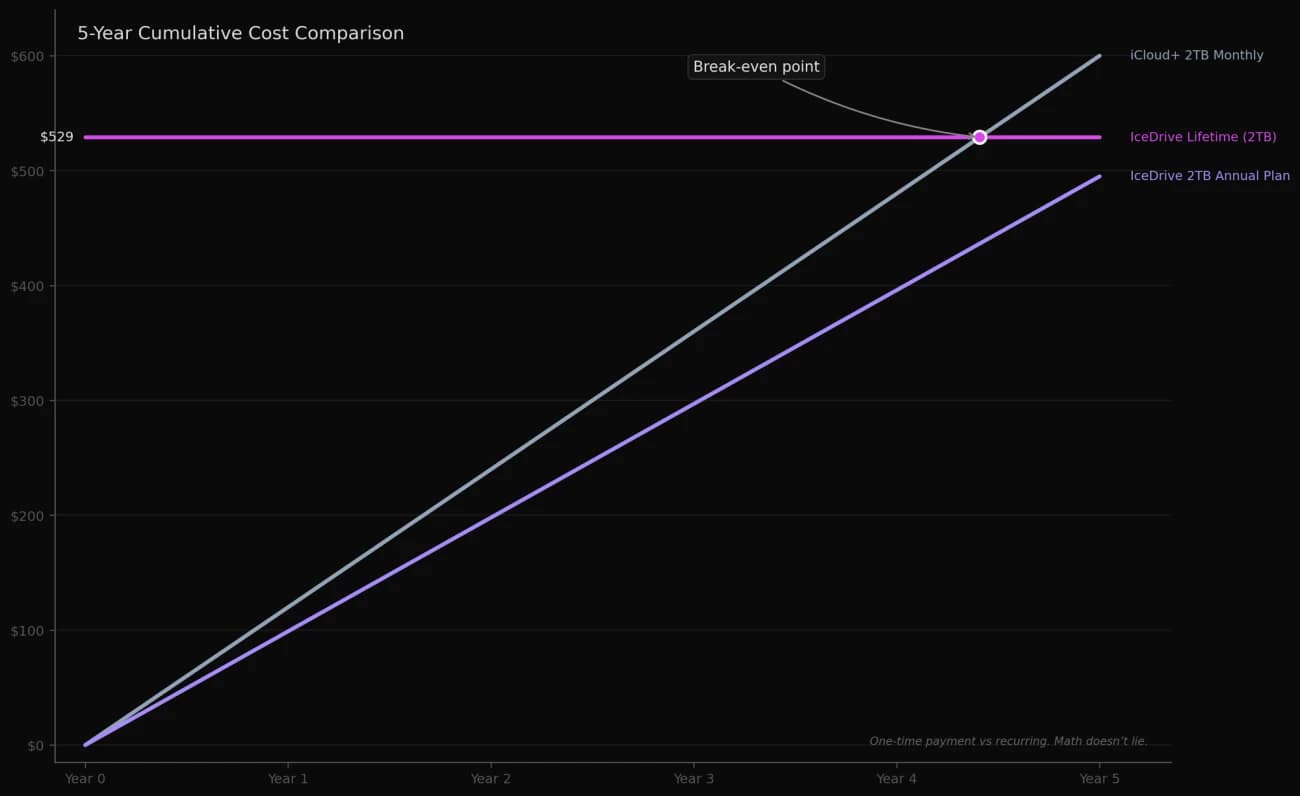
Run the maths over five years on this iCloud vs IceDrive 2026 comparison and the gap becomes hard to ignore. iCloud+ 2TB at $9.99 a month costs roughly $599 over five years, with absolutely no end in sight, ever, for as long as you own an iPhone. IceDrive’s equivalent Lifetime tier is a single payment that, around year four and a half, has already paid for itself against the monthly alternative, and every year after that is pure saving.
Lock in IceDrive Lifetime before prices rise → Get IceDrive’s current Lifetime pricing here
Will I Lose My Photos If I Switch? (The Fear Nobody Answers Honestly)
This is the question that actually stops most people considering an iCloud vs IceDrive 2026 switch, and it deserves a straight answer rather than the usual vague reassurance you get from a support forum.
What Happens If I Stop Paying for iCloud Storage?
Apple doesn’t delete your files the moment a payment fails, so take a breath. You typically get a grace period during which your account moves into a read-only style restricted state. If you go over your free 5GB limit without upgrading or downgrading sensibly, new photos and files simply stop syncing rather than existing ones being wiped instantly. That said, leaving it too long without resolving the storage overage can eventually put your data at genuine risk, so this isn’t a reason to be complacent, just a reason not to panic the moment you see a warning banner.
How Do I Get Thousands of Photos Off iCloud Safely?
The safest method is downloading your full resolution photo library to a computer first, using the Photos app or iCloud.com’s batch download tool, verifying the download completed fully, and only then uploading that same library into your new storage provider. Never delete anything from iCloud until you’ve confirmed the new copy is genuinely intact and readable. This exact process works identically whether you’re moving to IceDrive, pCloud, or anywhere else, so it’s a skill worth learning properly once.
Encryption and Privacy: Twofish vs Apple’s Black Box
Encryption is where this iCloud vs IceDrive 2026 comparison gets genuinely technical, so let’s keep it plain. IceDrive uses Twofish encryption on its encrypted storage tier, a respected, independently audited algorithm, though admittedly less universally adopted than the AES-256 standard most competitors default to. It’s not a red flag, but it is a legitimate point of difference worth knowing rather than glossing over in the name of a tidy sales pitch.
Apple, by contrast, encrypts iCloud data in transit and at rest, but does not offer end-to-end, zero-knowledge encryption across most of its default iCloud services. That means Apple itself, and by extension US authorities under existing legal frameworks, can technically access certain categories of stored data when compelled to do so. It’s a meaningful difference, and one Apple’s marketing tends not to dwell on.
What Is the Most Secure Cloud Drive?
There’s no single universal answer here, because “most secure” depends heavily on your personal threat model. IceDrive encrypts your files using Twofish once they reach its servers, which is solid, but Proton Drive goes a step further with true end-to-end, zero-knowledge encryption, meaning files are scrambled on your own device before they ever leave it, so not even Proton’s engineers can read them. For readers who want that maximum, mathematically provable level of privacy, our Proton Drive Pricing Plans 2026 breakdown covers exactly what that costs. IceDrive still sits in a strong, sensible middle ground for most Apple switchers: meaningfully more private than Apple’s default posture, just not quite at Proton’s zero-knowledge tier.
The Native App Experience: Which Feels More “Apple”
Here’s the genuinely surprising bit in this iCloud vs IceDrive 2026 comparison. IceDrive’s interface is often the closest thing to an authentically Apple-like experience among privacy conscious alternatives currently on the market. Its virtual drive mounts cleanly into Finder on macOS, and the design language is noticeably more polished and considered than most competitors in this space. That matters more than people expect, because you’re essentially asking someone to give up the deep native integration Apple has spent a decade perfecting, and if the replacement feels clumsy, they’ll simply drift back within a fortnight.
What If Neither Is Right For You?
To be properly fair to the wider market beyond this iCloud vs IceDrive 2026 comparison, if maximum zero-knowledge privacy is your only real priority and a subscription doesn’t bother you in the slightest, Proton Drive remains the stronger pick, and you can see the full breakdown on our Proton Drive Pricing Plans 2026 page. If raw bulk storage at the lowest long-term cost is your only priority instead, pCloud’s lifetime tiers are also worth a proper look. Neither of those choices makes IceDrive the wrong answer here, they simply serve a slightly different priority than the one this particular comparison is built around.
Who Should Actually Choose Each
Here’s how this iCloud vs IceDrive 2026 decision breaks down by user type.
Stick with iCloud if: you’re fully embedded in Apple’s ecosystem, rely heavily on Photos, Family Sharing, and Handoff, and genuinely don’t mind an open-ended monthly cost in exchange for that convenience never breaking.
Choose one of IceDrive’s subscription tiers if: you want flexibility to cancel any time, you’re not quite ready to commit to a lump sum yet, and you want a cleaner, more private alternative without fully overhauling your entire workflow overnight.
Choose a IceDrive Lifetime Plan if: you’re tired of subscriptions on principle, you know roughly how much storage you’ll need long term, and you’d genuinely rather pay once now than keep paying indefinitely for the rest of your Apple-owning life.
Verdict: The Scorecard
Right, let’s be properly honest rather than falsely balanced for the sake of looking neutral in this iCloud vs IceDrive 2026 verdict. Both of these products do their jobs. One of them just happens to respect your wallet a great deal more than the other.
| Category | iCloud+ | IceDrive |
|---|---|---|
| Price flexibility | ★★☆☆☆ | ★★★★★ |
| Privacy and encryption | ★★☆☆☆ | ★★★★☆ |
| Native app experience | ★★★★★ | ★★★★☆ |
| Free tier generosity | ★★☆☆☆ | ★★★★☆ |
| Long-term value | ★★☆☆☆ | ★★★★★ |
| Overall Score | 2.4 / 5 | 4.4 / 5 |
iCloud earns its stars purely on integration. If you live entirely inside Apple’s world and have never once questioned a bill, it does exactly what it promises, seamlessly, and that’s not nothing. But it loses ground fast the moment you actually look at what you’re getting for that convenience: no ownership, no lifetime option, and a privacy posture that’s adequate rather than impressive.
IceDrive isn’t perfect either, and it would be dishonest to pretend otherwise. Twofish encryption, while sound, isn’t quite the industry-standard AES-256 most security researchers default to recommending, and it doesn’t offer the fully zero-knowledge architecture that a maximum-privacy reader might want from Proton instead. But for the specific, extremely common situation this article was written for, an Apple user who’s just noticed a $9.99 charge and started asking questions, this iCloud vs IceDrive 2026 comparison has a clear answer: IceDrive is cheaper long term, more private by default, genuinely pleasant to use on a Mac, and it offers you the one thing Apple has never once been willing to give you, a way out.
Compare IceDrive’s live pricing here → See current IceDrive plans
iCloud vs IceDrive 2026 (FAQ)
Here are the most common questions readers ask about this iCloud vs IceDrive 2026 comparison:
Is there a way to permanently buy iCloud storage?
No. Apple has never offered a one-off, lifetime iCloud+ storage option. Every tier is a recurring subscription with no permanent buyout available, and there’s no indication that will change.
Is IceDrive trustworthy?
Yes. IceDrive is a UK-registered company with a public pricing history, an established track record since 2019, and client-side encryption on its higher storage tiers.
Will I lose my photos if I stop paying for iCloud storage?
Not immediately. Apple typically applies a grace period and restricts syncing before any deletion risk arises, though it’s best practice to download a full backup before letting any payment lapse regardless.
How much does IceDrive cost?
IceDrive offers a free 10GB tier, subscription plans from around $5.99 a month, and Lifetime one-off plans starting from $199 for 100GB, up to $529 for 2TB.
What is the $9.99 a month for iCloud?
It’s Apple’s iCloud+ 2TB storage tier, separate from Apple Music, Apple TV+, or other Apple One subscriptions on your statement.
Is Icedrive good for large files?
Yes, its virtual drive mounts as a local drive, making large media and archive files noticeably easier to manage than browser-only upload systems.
Which is better, pCloud or IceDrive?
It depends on priority. In most iCloud vs IceDrive 2026 or pCloud comparisons, pCloud tends to edge out on bulk lifetime storage value, while IceDrive tends to edge out on interface polish and encryption transparency. Both are strong choices depending on what you personally value most.
Sources:
- [1] Apple, “iCloud+ plans and pricing,” Apple Support. ↩¹ ↩² ↩³ ↩⁴
- [2] IceDrive, “Plans and Pricing,” IceDrive.net. ↩¹ ↩² ↩³ ↩⁴
- [3] IceDrive, “Lifetime Plans,” IceDrive.net. ↩¹ ↩²