Proton Drive Roadmap 2026:
What Is Actually Shipping
in the Second Half of the Year
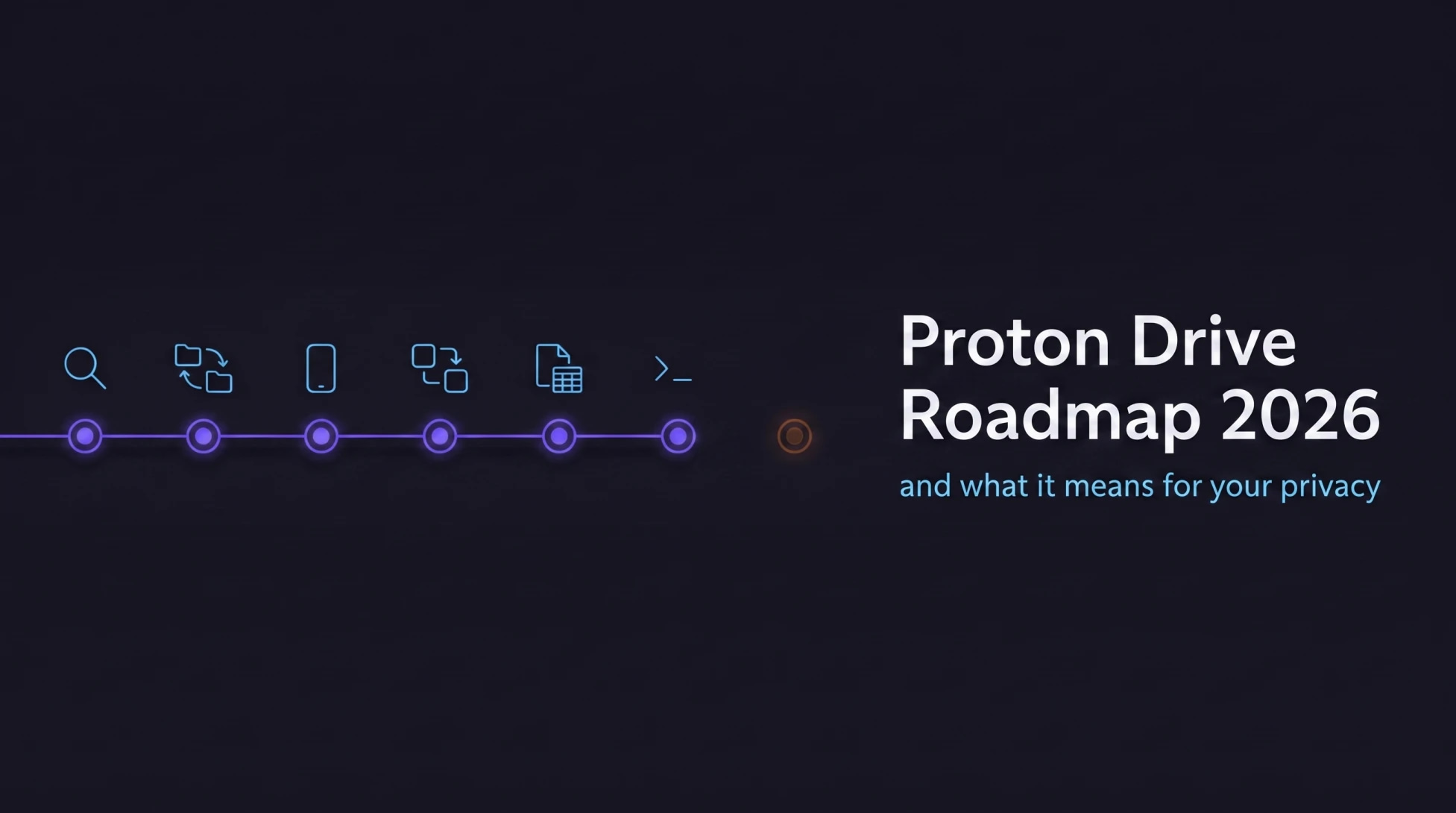
TL;DR: The Proton Drive roadmap 2026 covers the second half of the year, and it lists six user-facing changes, one public slip, and not a single release date.
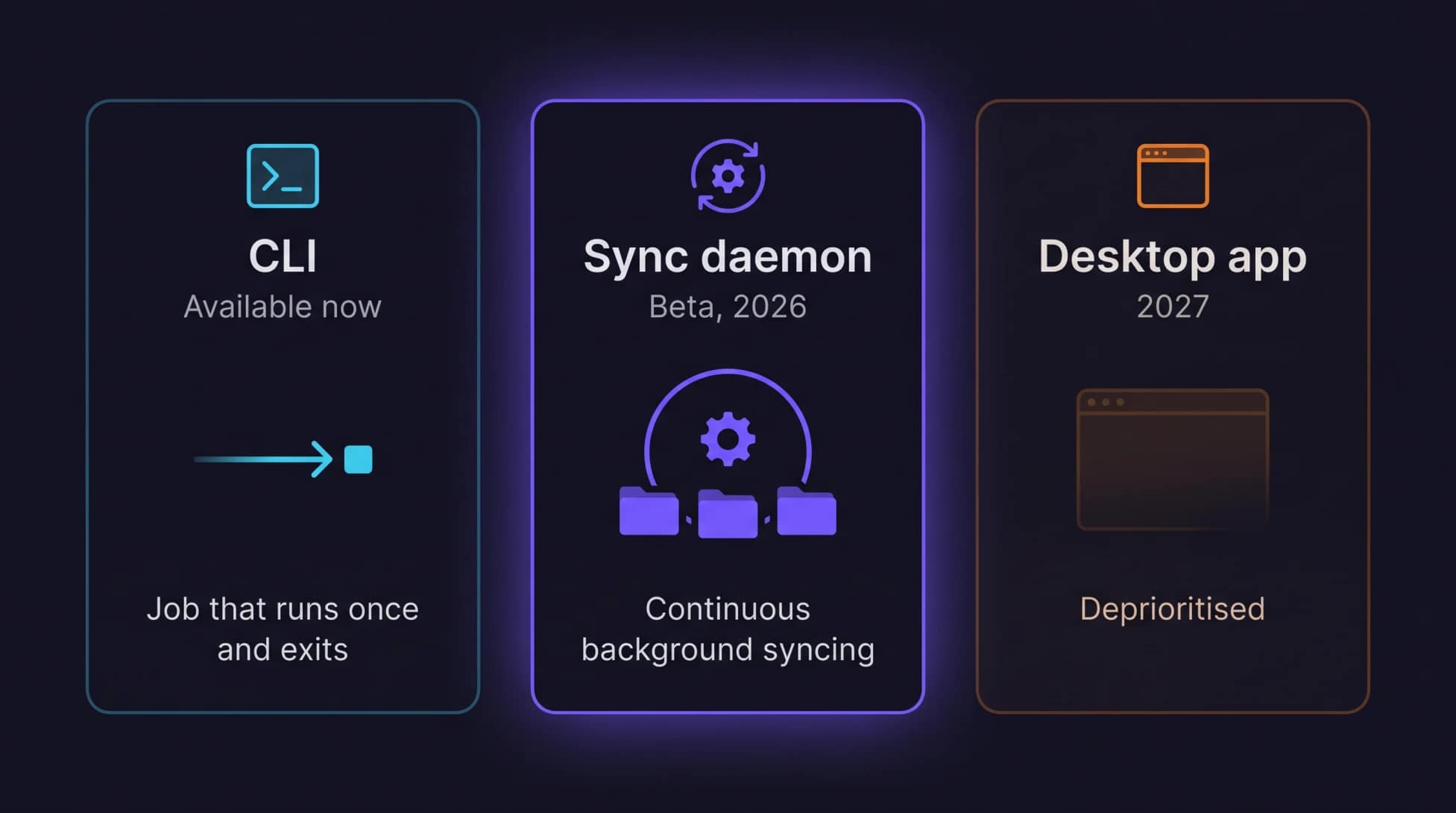
The six: search across every client, folder sync on macOS, iOS Files integration coming back, a Google Drive importer that removes the Takeout step, more work in Docs and Sheets, and a Linux beta. Read that last one twice. The Linux release is a background daemon with no interface attached, and the desktop app is a 2027 job.
The slip is Crypto v2. It arrived on the roadmap already marked as 2027, in writing, under a heading that begins with the word transparency.
Jump to
What is on the Proton Drive roadmap 2026?
Seven items for the second half of the year, and one of them was already late when the roadmap went up.
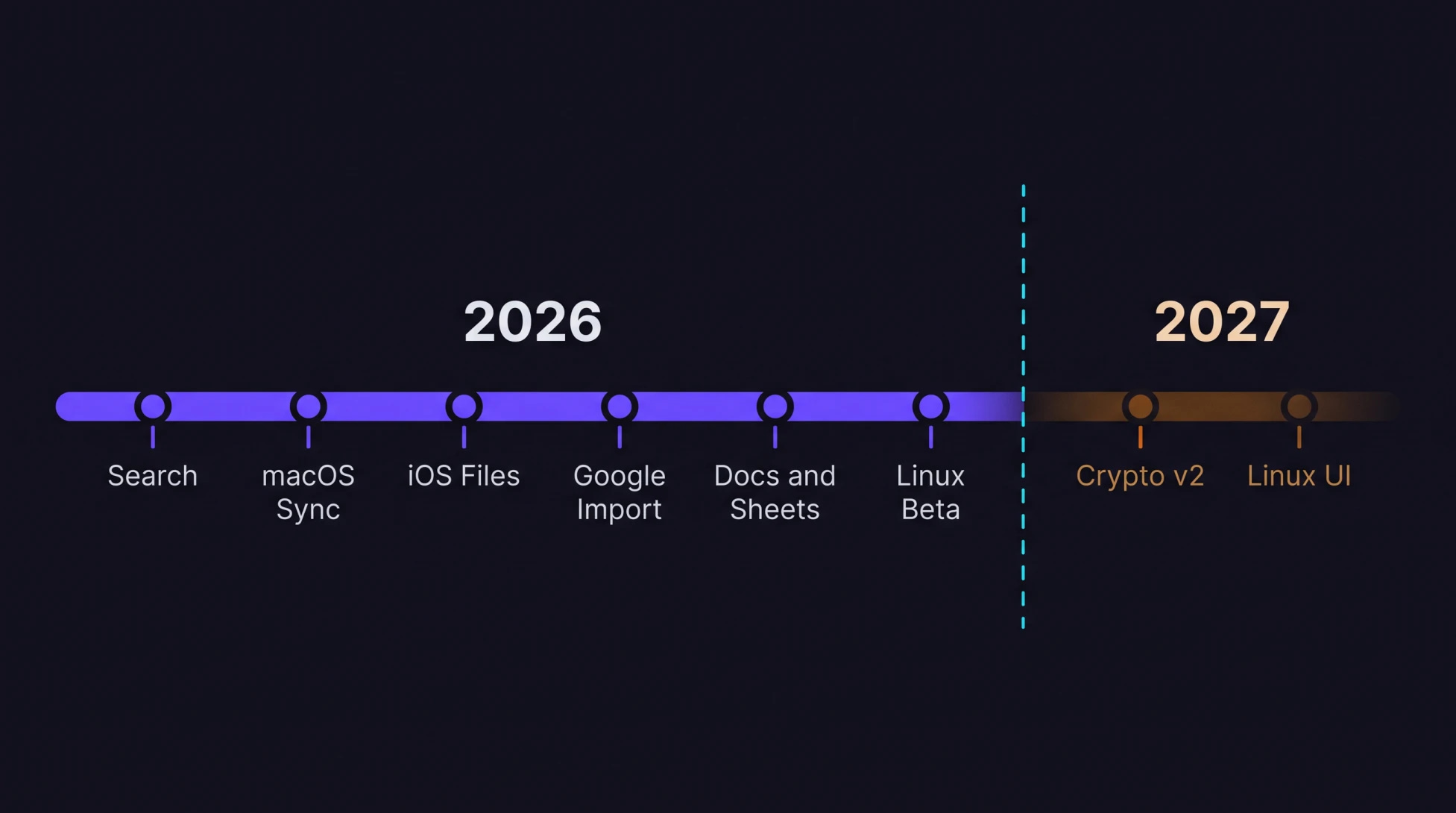
Six are aimed at 2026. Crypto v2 landed on the list pre-marked as a 2027 job. Every roadmap item below comes from a technical post that an engineering director on the Proton Drive team published to r/ProtonDrive on 26 August 2026, ahead of Proton’s own blog version. Pricing and older figures are sourced separately at the foot of the page.
| Roadmap item | What actually changes | Where it stands |
|---|---|---|
| Search | Search by metadata now, file contents later. Mobile gets search at all for the first time. | Design finished, in implementation. Shipping in waves. |
| macOS folder sync | Pick any folder on a Mac, keep it synced, much as Windows does now. | In development. Called “by far the biggest missing feature on Mac”. |
| iOS Files | Proton Drive reappears inside the iOS Files app. | In development. Go crypto runtime being swapped for Rust. |
| Google Drive importer | Move a Google Drive account across without Google Takeout. | Internal testing. Due later in 2026. |
| Docs and Sheets | Requested features, dark mode among them, plus a lot of invisible repair work. | In development. Separate roadmap post promised. |
| Linux beta 🐧 | A background daemon syncing a configurable list of directories. No interface. | Beta intended in 2026. Desktop app 2027. |
| Crypto v2 | Faster remaining crypto operations, simpler model underneath. | Slipped to 2027. Fragments land in the SDK during 2026. |
Swipe the table sideways to see every column.
Notice what the table does not have. Dates.
“This year” is as precise as Proton gets, and one item has already fallen out of the year entirely. Read the whole list as intent. Nobody has committed to a calendar.
Why did this roadmap land on Reddit before Proton’s blog?
Because Proton wanted the technical audience to see the technical version first.
The post says as much. Plainer-English descriptions are being held back “for the upcoming Blog post where we will publish the roadmap ‘officially'”, so the subreddit got the engineering detail and everybody else will get the marketing copy in a few weeks.
A smaller commitment sits in the preamble. Proton says it has “taken note of the desire for more frequent high-level updates on the technical and roadmap sides of Drive”. Its last formal roadmap went up on 24 April, covered spring and summer, and signed off, promising to come back in the autumn.
An update every six months is worth more to me than any single item below it. It is the only thing on this page you can audit. A cadence like that is also the first thing companies drop when a quarter goes badly, so diarise the autumn one and see whether it turns up.
Why is search the hardest thing on this list?
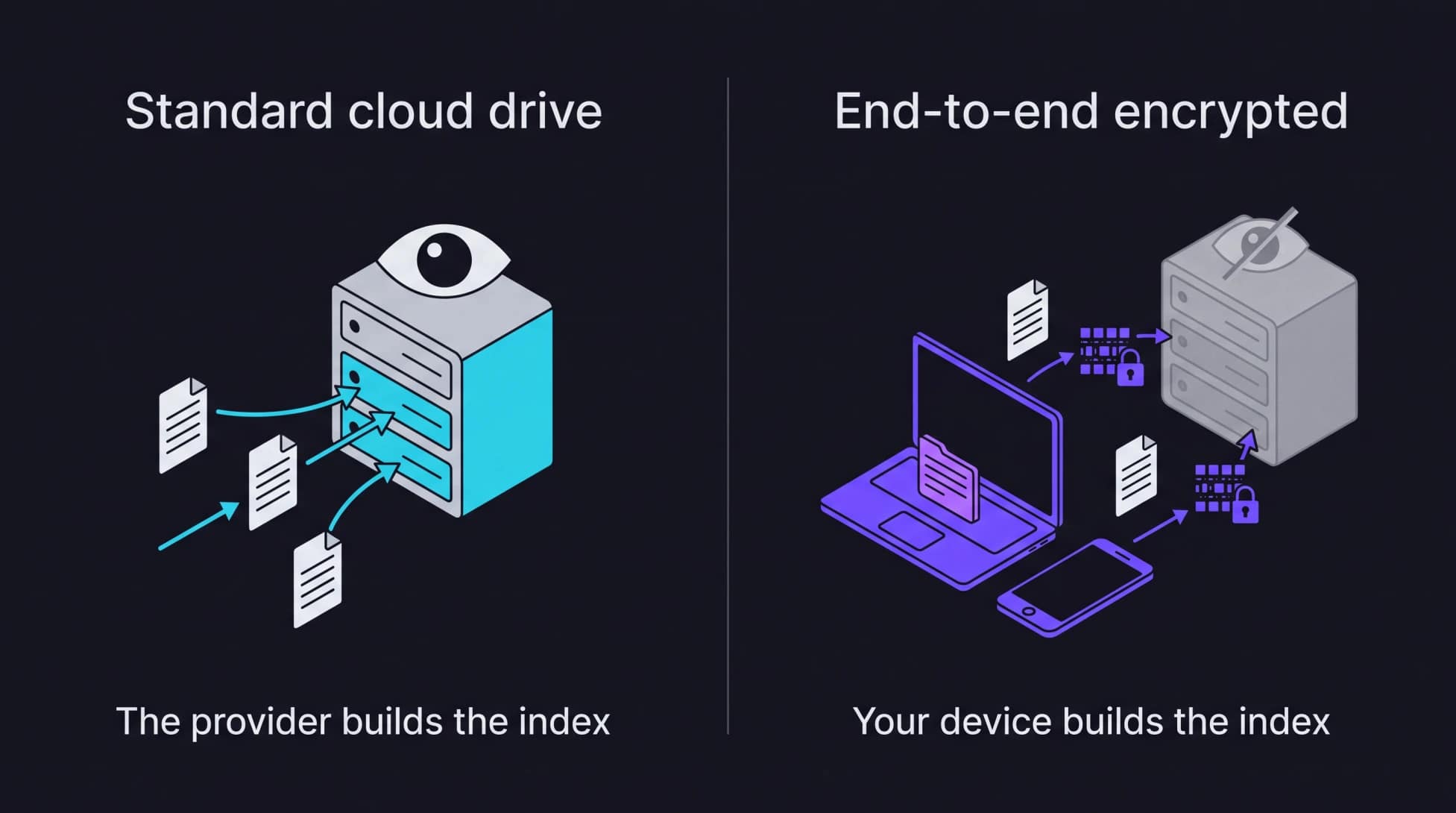
Proton’s servers cannot read your files. Search normally depends on exactly that.
A conventional cloud drive indexes your content server-side. Fast, cheap, and only possible because the provider can read everything you own. End-to-end encryption removes that option, so the indexing has to happen on your devices and the index itself has to be encrypted too.
The design is finished end to end, Proton says, and the work is now in implementation. Search arrives in waves: more metadata fields first, full content search last. Mobile gets search at all for the first time. Results come back in two tiers, with the quick relevant matches surfacing straight away while a longer exhaustive pass streams in behind them.
The staged rollout is not caution for its own sake. Content indexing is expensive, and Proton wants that heavy step to happen once per file and never again. Botch the first attempt and everyone re-indexes their entire Drive. Nobody should have to do that twice.
One detail if you build on Drive: search is being written once, inside the SDK. Every client inherits it. Third-party apps too, and the Proton Drive CLI once search reaches beta.
The four terms this roadmap keeps using
- Sync Engine
- The component that watches folders and keeps them matched with the cloud. Proton built it for Windows, then pulled it out so it can run anywhere. macOS gets it next, then Linux.
- SDK
- The shared library every Proton Drive app now talks to instead of the raw API. It handles encryption, chunking and thumbnails so the apps do not have to.
- Daemon
- A program that runs in the background and reacts to changes as they happen. This is what the Linux release will be.
- Crypto v2
- The next version of Proton Drive’s encryption model, aimed at the operations that are still slow. Now due in 2027.
macOS folder sync is coming, and Linux users should care
Folder sync reaches macOS because Proton made its Sync Engine platform-agnostic, and the Linux client will launch on that same component.
Mac users will pick folders and have them stay in sync, much as Windows does now. Proton calls it “by far the biggest missing feature on Mac”. Hard to argue.
macOS handles files more like Linux does than Windows ever has. That is why the Mac work carries over, and why one team’s effort lands on two platforms.
The Sync Engine had been kept separate from the Windows app from day one, so no redesign was needed. Nobody gets promoted for a decision like that. Everybody is benefiting from it now.
What will the Proton Drive Linux beta actually do?
It will sync folders in the background. It will not have an interface.
The beta is expected in 2026 as a headless daemon. That daemon runs quietly, keeps a configurable list of directories matched with Drive, and behaves underneath like the Windows and macOS clients do. A graphical client is planned, but Proton says it “probably will not be ready to launch this year”, and the roadmap summary puts that interface in 2027.
The daemon is still a meaningful release, because it is the one thing the Proton Drive CLI cannot be. The CLI runs a job and exits, which is exactly what you want in a cron entry and exactly what you do not want when a file changed thirty seconds ago.
A “one-shot sync” command might follow, no promises attached. Once the daemon ships, Proton says it becomes the officially supported way to keep folders in sync on Linux.
Proton is also hiring a full-time Linux developer. Do the arithmetic on what that implies about the current headcount.
If your workflow depends on Proton Drive showing up inside Nautilus or Dolphin, this is not your year. It might be your 2027.
Leaving Google Drive without the Takeout dance
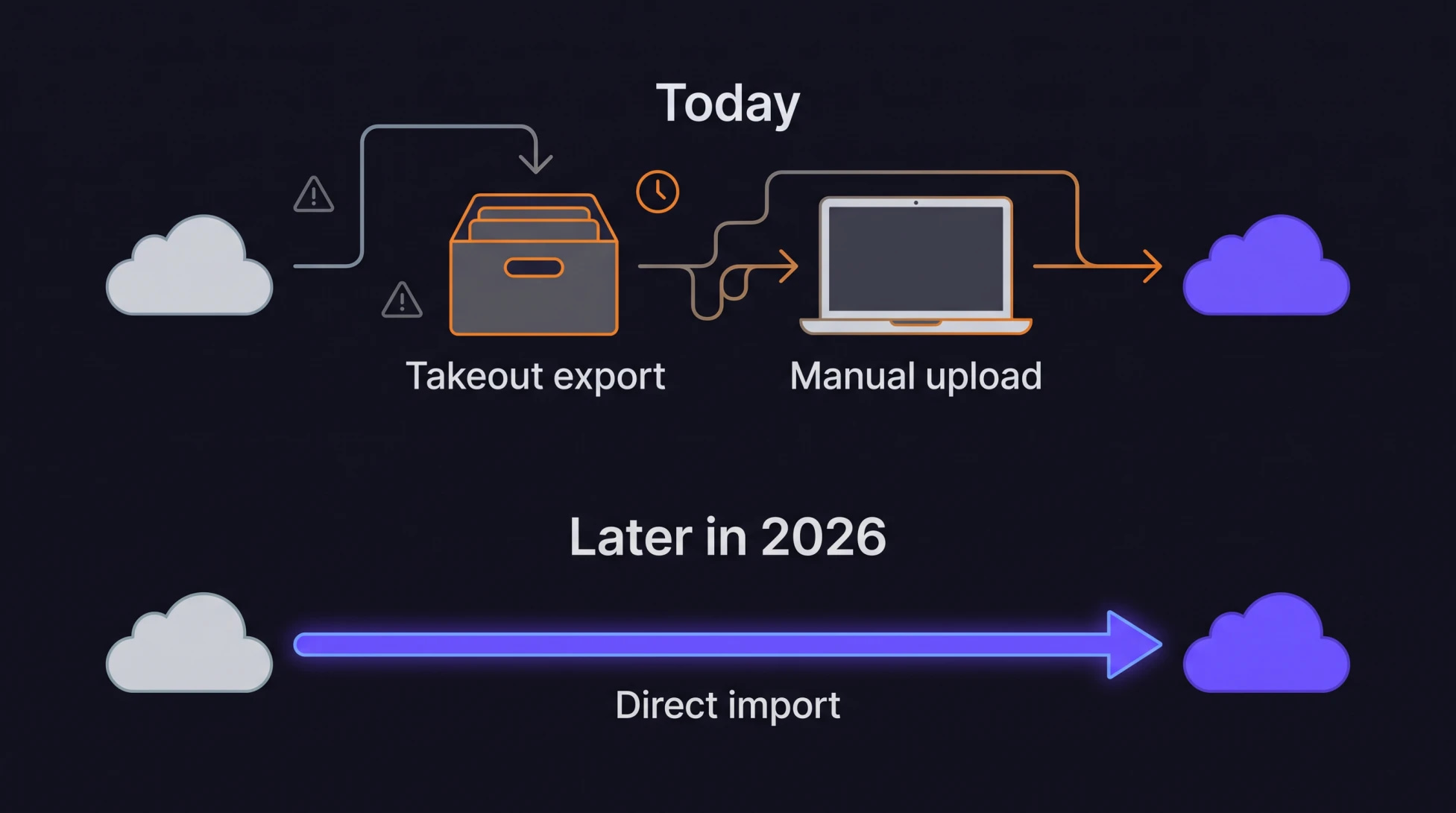
Proton is building a Google Drive importer, so moving off Google will stop meaning a trip through Google Takeout.
If you have done it, you know the shape. Request the export. Wait. Download a stack of zip files. Then either upload them by hand or drop the lot onto a Windows machine and let the desktop client chew through it overnight.
Proton’s verdict on that process: “We know it’s bad, and we’re going to make it a lot easier.” They have known it was bad for as long as Drive has existed, so the number to watch is not how bad. It is how many years.
The replacement is in internal testing and due later this year. The proof point is the engineering director’s own Google Drive account. Opened April 2012, north of 100 GB, moved across without complaint.
A decent test of mess. Not much of a test of scale.
Even so, this is the item on the Proton Drive roadmap 2026 most likely to move people. Migration friction is what keeps accounts parked on Google Drive, not any deep affection for Google.
Remove the friction and it becomes a straight question of privacy and price. Proton wins the first outright and holds its own on the second. Our piece on why I quit Google Drive in 2026 covers what the switch costs you day to day.
Do this now: open the free account before the importer arrives. Then, when it lands, you will already know whether you like the thing you are migrating into. Nothing to pay, and nothing to cancel if you hate it. Open a free Proton Drive account.
iOS Files integration is coming back, and the fix is Rust
Files integration returns once the Rust rewrite lands, and not before.
The Files extension runs inside a tight iOS memory budget. Going over it is what broke the feature. Underneath, a Go runtime had been handling the cryptographic work on iOS. That runtime is being torn out.
The apology is more interesting than the rewrite. The engineering director says the removal was communicated badly, and commits to more lead time on breaking changes in future, specifically because such changes affect whether somebody renews a subscription. Most vendors do not put that in writing.
A regression test is going in, so the next time something breaches the memory limit, somebody finds out before it ships. The work gets described as “deep surgery on the application”, which is engineer for “do not expect this next month”.
The Rust migration should make iOS faster generally. By how much, and by when, nobody has said.
How is Proton measuring Drive’s speed and reliability now?
Against a rival it refuses to name, on a test rig it controls down to the network conditions.
Until this year Proton had never run automated competitor comparisons. Now Drive goes head to head with “Anonymous Major Competitor” in a repeatable environment, with network quality, hardware resources and egress location all controlled.
Unnamed competitor. Unpublished results. Proton’s own hardware. As benchmarks go, this is a diary entry.
Useful all the same, because the scenarios are things people genuinely do to a cloud drive. Uploading 10,000 photos from iOS. Pulling 10 GB of 1 MB files down on the web. Bottlenecks get ranked by Amdahl’s Law, which in practice means fixing whichever step owns the largest share of the total time first. Rarer than you would think.
The crash-rate and transfer-success improvements come mostly from the SDK migration and the code around it. Those 6,991 lines vanished from Android because the client no longer needs to know what a thumbnail or a file chunk is, and every client should have its direct HTTP calls stripped out by the end of the year. Or “very close” to it. Proton’s wording, not mine.
Docs and Sheets get a target of their own: 90% fewer errors by the end of 2026. Docs is slow to load and power users keep hitting problems in Sheets, so both are being pulled apart into a core and an SDK, the same treatment the Drive clients received. Extra hires have gone into that team. Dark mode is one of the requests Proton says the team has heard.
What slipped, and why it is the most useful line in the post
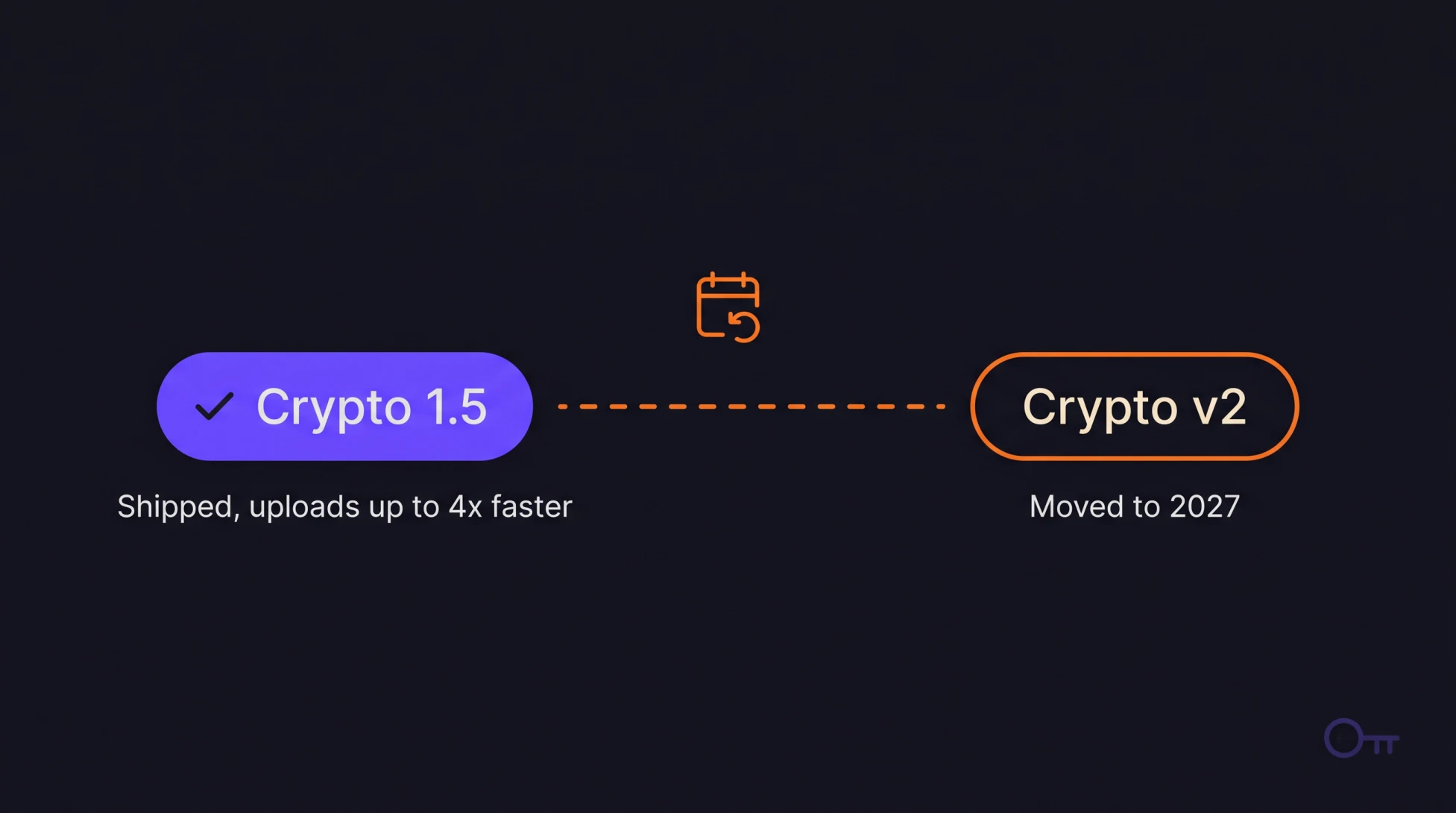
Crypto v2 has moved to 2027. Proton wrote that down itself.
The item carries the label “transparency: will slip to 2027”, and the explanation is that the work needs longer to cook. That is the whole disclosure. No reframing, no silent deletion between one roadmap and the next.
Crypto v2 follows Crypto 1.5, the release that made uploads up to 4x faster on most clients. Version 2 goes after the operations that are still slow and is meant to simplify the model underneath, and Proton expects a bigger jump than 1.5 delivered. It is also the last thing standing between the Proton Drive SDK and a stable v1.0.
Fragments of it will land inside the SDK during 2026, with API changes attached. Build against the SDK, not the raw API, and expect churn.
A roadmap that only lists wins is a press release. This one names a slip, explains it, and warns developers what will break.
What the Proton Drive roadmap 2026 does not promise
Most of what follows comes from the missing dates.
- No dates. “This year” is the whole of it.
- No Linux desktop app in 2026. The beta is a daemon, the graphical client is pencilled in for 2027, and Proton hedges even that with a “probably”.
- No full content search at launch. Early waves widen metadata search. Content search is the destination, not the first stop.
- No token authentication for the CLI. Proton wants it, is working with its Accounts team on it, and will not promise it.
- No guaranteed finish to the SDK migration. Proton expects to be “very close” by year end. Close is not done.
- No public beta for the Google Drive importer. Still internal, and Proton has not said a word about how the transfer actually works, which matters if you care whether it touches your Google credentials.
- No change to storage or pricing. Free stays at 5 GB.
- No independently verified numbers. The order-of-magnitude gains and the 90% error target are Proton’s own measurements, on Proton’s own dashboards, against a competitor Proton will not name.
None of that makes the Proton Drive roadmap 2026 dishonest. Roadmaps are wish lists with a letterhead, and this one is better than most. The team shipped Crypto 1.5 and cut 6,991 lines out of the Android client this year, so the intent is worth something. Just not a booked migration weekend.
Should you move to Proton Drive now, or wait?
Move now if you are on Windows, live mostly in a browser, or are leaving Google. Windows already has folder sync. The web client is the best of the lot. An importer arriving later only makes an easy migration easier.
Wait if a missing feature is load-bearing. Mac users who need folder sync are the obvious case, and they are waiting on a deliverable with no date on it. Anyone who wants a graphical Linux client is waiting on 2027.
There is a third option, and most people should take it. Run both. Nothing on the Proton Drive roadmap 2026 forces a decision this month.
The free plan is 5 GB, it does not expire, and 5 GB is enough to test real upload speeds, the editors and the mobile apps on your own files while your current provider carries on doing its job. For how it stacks up against the obvious alternatives, we have Dropbox vs Proton Drive and Proton Drive vs pCloud.
| Plan | Storage | UK price per month | Worth knowing |
|---|---|---|---|
| Free | 5 GB | £0 | Same encryption as paid. 7-day version history. |
| Drive Plus | 200 GB | £3.19 | Up to 200 versions per file, kept 10 years. |
| Unlimited | 500 GB | £7.99 | Adds Mail, VPN, Pass and Calendar. |
| Duo | 2 TB | £11.99 | Two users. |
| Family | 3 TB | £18.44 | Up to six users. |
Swipe the table sideways to see every column.
Try 200 GB before you migrate into it
Every file is encrypted on your device before it leaves, on every plan, the free one included. Start on 5 GB for nothing. Or take Drive Plus: 200 GB, up to 200 versions of every file kept for ten years, and £1 for the first month. Readers outside the UK see $1 or €1. It renews at £3.99, $4.99 or €4.99 a month, or £1.94, $2.99 or €2.99 a month paid annually. Thirty days to get your money back if you hate it.
Affiliate link. We earn a commission if you subscribe, you pay the same either way, and the free plan earns us nothing at all.
The BAIZAAR verdict
The Proton Drive roadmap 2026 is the most credible roadmap Proton Drive has published, and the reason is that it prints its own failures. A slipped cryptography release. A badly handled iOS regression. A Linux beta shipping without an interface. An importer with one test account behind it.
Companies that publish their own failures are, in my experience, the ones with fewer left hidden. Not proof. A decent prior.
Ignore the feature list for a moment, because the shape of the year is simpler than it looks. Proton spent the first half of 2026 rebuilding plumbing nobody could see. The second half is when that starts producing things people can. Search, Mac sync and Linux sync all come out of the same work, which is why they cluster in the same six months.
So if you have been waiting for Proton Drive to stop being the privacy option with holes in it, this is the year Proton says most of them close. Proton also said Crypto v2 was a 2026 job.
Proton Drive roadmap 2026 FAQ
When is the Proton Drive Linux app coming out?
Proton intends to release a Linux beta in 2026, with no date announced. That beta is a headless sync daemon, not a desktop application. There is also a full-time Linux developer job advert open, so the timing depends partly on who applies.
Will the Proton Drive Linux client have a graphical interface?
Eventually. Not in 2026. Proton says a UI client “will come along as well, but it probably will not be ready to launch this year”, and its own roadmap summary puts that interface in 2027. What lands first is a background daemon syncing a configurable list of directories, which is what most of the Linux threads have been asking for anyway.
Is Proton Drive getting full-text search?
Yes, but in waves. Design done, code in progress, no date. More metadata fields come first, on every client including mobile, and full content search is the stated end point. Indexing has to happen on your own device because the files are encrypted. That is the whole reason this is taking so long.
When will Proton Drive get folder sync on macOS?
macOS folder sync is on the roadmap for the second half of 2026, with no committed date. The Windows Sync Engine has been made platform-agnostic and is being ported to macOS first. Once it arrives, choosing folders to sync on a Mac will work much as it already does on Windows.
Is Proton Drive coming back to the iOS Files app?
Yes. Proton says it intends to restore iOS Files integration in 2026. The delay is a deep rewrite: the Go runtime used for cryptography on iOS is being replaced with Rust, and a regression test is going in so that the next time something breaches the memory limit, somebody finds out before it ships.
Can I move from Google Drive to Proton Drive without Google Takeout?
Not yet, but an importer is in internal testing and due later in 2026. Today the only route is Google Takeout followed by a manual upload, or dropping the archive onto a Windows machine and letting the desktop client sync it.
The new importer has been tested against a Google Drive account holding over 100 GB and dating back to April 2012. How the transfer actually works has not been explained.
What is Proton Drive Crypto v2, and why did it slip to 2027?
Crypto v2 is the next version of Proton Drive’s encryption model, aimed at the operations that are still slow and at simplifying the architecture underneath. The 2026 target has been publicly moved to 2027, with Proton saying the work needs longer. It is the last major blocker for a stable Proton Drive SDK v1.0.
Is Proton Drive faster than Google Drive or Dropbox in 2026?
Nobody outside Proton can say. Drive is benchmarked against a competitor Proton declines to name, and crash rates and transfer success rates improved by roughly an order of magnitude across most clients during 2026. Internal figures, unaudited, head-to-head speed results unpublished. Encryption costs cycles, so parity is the sensible expectation.
What is changing in the Proton Drive CLI?
Recent releases added photos and albums support, integration with the Linux pass password store, and a batch of usability fixes. Experimental search follows once search reaches beta.
More commands are promised, along with documentation that does not assume you already know the answer. The team wants token-based authentication. Proton has not promised it. Our Proton Drive CLI guide covers what the tool can do today, including the headless login problem.
Does the roadmap change the Proton Drive free plan?
No. Nothing on the roadmap for the second half of 2026 alters storage limits or pricing. The free plan stays at 5 GB with the same end-to-end encryption as the paid tiers. Nothing here touches the price list. See our guide to Proton Drive free storage in 2026 for what the free tier gets you.
Where did the Proton Drive roadmap 2026 come from?
An engineering director on the Proton Drive team posted it to r/ProtonDrive on 26 August 2026, as a technical preview ahead of the official blog version. The post runs to four parts: user-facing features, performance and quality, the SDK and CLI alongside cryptography, then a summary.
How we verified this
Every claim about the Proton Drive roadmap 2026 on this page was traced back to Proton’s public statements on 27 August 2026, one day after the source post appeared.
Where Proton stated an intention, this page says intention. Where Proton gave an internal target, this page says target and flags it as unaudited. Quotations are reproduced word for word.
Nothing here is a leak, an anonymous source or a rumour. Nothing on the roadmap is available today unless the text says so. UK pricing was checked on the same date against Proton’s own pricing page.
Sources
- Proton Drive roadmap for the second half of 2026, r/ProtonDrive, 26 August 2026. Primary source for every roadmap item here.
- Proton Drive roadmap, Proton. Shipped features and release dates.
- Proton product roadmaps for spring and summer 2026, Proton, 24 April 2026.
- Proton Drive cryptography update, Proton. Crypto 1.5 and the 4x upload figure.
- Proton Drive got faster and easier to use in early 2026, Proton, 14 April 2026.
- Proton Drive pricing, Proton. Plan tiers and the 30-day money-back guarantee.
- Proton Drive CLI documentation, Proton.
Related BAIZAAR guides
- Proton Drive CLI: backups, cron jobs and the headless login problem
- Dropbox vs Proton Drive 2026: the honest comparison
- Why I quit Google Drive in 2026
- Proton Drive pricing and plans in 2026
- Proton Drive vs iCloud Photos in 2026
- Proton Unlimited review 2026