
Proton Drive vs iCloud Photos:
Which Actually Protects Your
Memories in 2026?
Date Published: 22/06/2026 / Author: Baizaar Lee / Last Updated: 22/06/2026
TL;DR: The Quick Answer
If you want absolute privacy for your digital memories, Proton Drive vs iCloud Photos 2026 is not even a fair fight; Proton Drive is the clear winner. This guide is for iPhone users who are tired of big tech data harvesting but still rely on the convenience of automatic mobile backups. The core problem is the eternal trade-off between the seamless convenience of the Apple ecosystem and the uncompromising security of true zero-knowledge encryption. Proton Drive now fully supports iOS photo auto-backup, making it a viable daily driver for protecting your images.
While Apple iCloud Photos offers opt-in Advanced Data Protection, Proton Drive applies end-to-end encryption by default, ensuring nobody can scan your files. Switch to Proton Drive if you value your privacy over slight ecosystem friction.
You can even test the auto-backup functionality with Proton Drive Plus has a 1-month introductory offer for just $1.00 here.
- TL;DR: The Quick Answer
- Convenience in the Proton Drive vs iCloud Photos 2026 Debate?
- Proton Drive Zero-Knowledge Architecture vs Apple ADP
- Proton Drive vs iCloud Photos 2026: Does Proton Auto-Backup iOS Photos?
- Privacy Risks of Centralised Cloud: Proton Drive vs iCloud Photos 2026
- Pricing Face-Off: Proton Drive vs iCloud Photos 2026
- Proton Drive vs iCloud Photos 2026: Why Proton Unlimited Wins
- Proton Drive vs iCloud Photos 2026: Moving Your Photos from Apple to Proton
- Analysing Cross-Platform Compatibility
- Proton Drive vs iCloud Photos – Comparison
- Proton Drive vs iCloud Photos 2026: How Swiss Privacy Laws Protect Your Data
- The Verdict: Who Should Stay and Who Should Switch
- Proton Drive vs iCloud Photos (FAQ)
- Proton Drive vs iCloud Photos – Conclusion
Convenience in the Proton Drive vs iCloud Photos 2026 Debate?
Apple iCloud Photos is brilliantly simple. You take a photo on your phone, and it appears on your Mac seconds later without any manual intervention. That fundamental simplicity is exactly why billions of users never question what happens to their data once it leaves their physical device. However, that convenience carries a significant privacy tax that becomes more apparent every year.
When you use standard Apple iCloud Photos, Apple holds the encryption keys on their servers. This means the company has the technical capability to scan, view, or hand over your memories if compelled by law enforcement or a rogue internal policy. Privacy-conscious users are leaving the Apple ecosystem because corporate rules are always subject to change.
A few years ago, Apple considered implementing on-device CSAM scanning for iCloud photos. While they eventually abandoned that specific consumer plan following severe backlash from civil rights organizations like the Electronic Frontier Foundation (EFF), the initial intention to scan personal photo libraries remains a glaring user-reported signal of where big tech priorities truly lie.
Relying entirely on a single corporate giant for your most intimate memories is a severe vulnerability. Apple iCloud Photos locks you tightly into their specific hardware cycle. If you ever decide to switch to Android or adopt a Linux workflow, liberating a massive photo library from iCloud is a notoriously miserable and technically frustrating weekend project. You are paying for seamless convenience with your personal data sovereignty. When evaluating the core merits of Proton Drive vs iCloud Photos 2026, you must critically ask yourself who truly owns your digital history. The Proton Drive vs iCloud Photos 2026 dilemma is ultimately about data sovereignty.
Proton Drive Zero-Knowledge Architecture vs Apple ADP
The technical divide between these two platforms comes down to exactly who holds the decryption keys. Apple iCloud Photos does offer Advanced Data Protection (ADP), which provides end-to-end encryption for most iCloud data. However, Apple’s Advanced Data Protection is strictly an opt-in feature. Most everyday users never enable it, leaving their photo libraries entirely vulnerable to server-side breaches or platform-wide scanning initiatives.
Proton Drive operates on a fundamentally different, user-first philosophy. It uses true zero-knowledge encryption by default for every single user. When you upload a photo to Proton Drive, it is encrypted locally on your device before it ever travels over the internet. Proton does not hold the keys. They cannot see your photos, they cannot scan them for AI training data, and they cannot hand them over to authorities because they simply cannot decipher the files mathematically.
“Proton Drive applies zero-knowledge encryption out of the box.
BAIZAAR.tools
You don’t have to dig through settings menus to secure your fundamental right to privacy.”
This zero-knowledge architecture is protected by strict Swiss privacy laws, placing your data entirely outside the jurisdiction of US or EU mass surveillance programs. For anyone serious about privacy-focused cloud storage, the technical distinction is abundantly clear. Apple requires you to jump through menus and actively trust their internal infrastructure, whereas Proton builds the protection directly into the mathematical foundations of the service. In the ongoing debate of Proton Drive vs iCloud Photos 2026, default zero-knowledge security always beats opt-in security models. Choosing between Proton Drive vs iCloud Photos 2026 means deciding if you want privacy by default.
Proton Drive vs iCloud Photos 2026:
Does Proton Auto-Backup iOS Photos?
Yes. The biggest historical barrier to leaving Apple iCloud Photos was the lack of a smooth, automated backup system that operated quietly without draining the battery. In 2026, Proton Drive completely supports reliable auto-backup for iOS devices.
The setup process is incredibly straightforward and takes less than a minute. You download the Proton Drive app, navigate to the Photos tab, and tap to enable backup. You grant the app full access to your photo library, and it handles the rest silently in the background. The application automatically encrypts each photo and video on your iPhone before securely transferring it to your cloud vault.
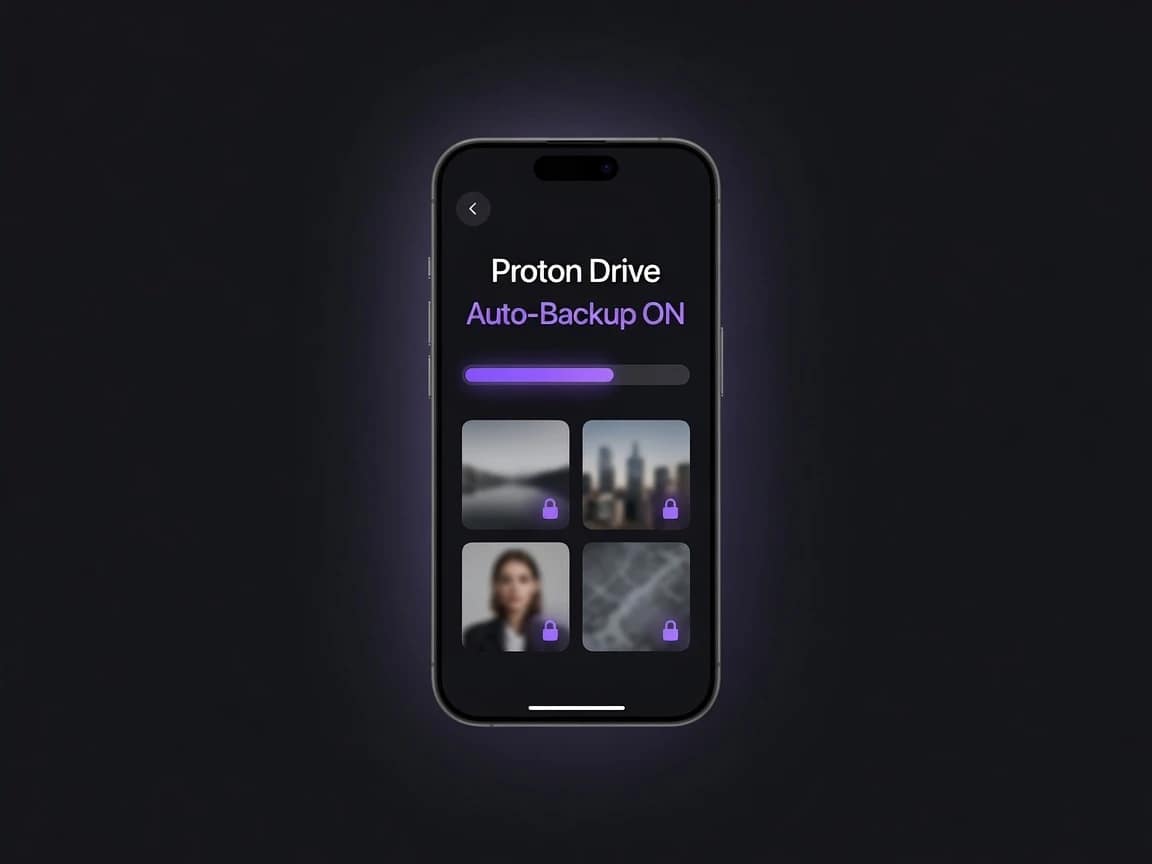
Recent architectural updates have made this process much smoother and far more competitive. Thanks to the unified Drive SDK launched in June 2026, Proton Drive upload speeds are now up to four times faster. This makes the initial sync of a large camera roll far less painful than it was in previous years. It works quietly and efficiently, finally matching the baseline convenience of Apple iCloud Photos without compromising your fundamental data rights. When assessing Proton Drive vs iCloud Photos 2026 for daily usability, the historical speed gap has practically vanished. This makes Proton Drive vs iCloud Photos 2026 an easy comparison for speed and efficiency.
Privacy Risks of Centralised Cloud:
Proton Drive vs iCloud Photos 2026
When evaluating the full scope of Proton Drive vs iCloud Photos 2026, you must understand the inherent risks of centralized data hubs. The Proton Drive vs iCloud Photos 2026 security analysis proves decentralisation matters. Apple operates a massive, globally distributed server network. While their security is undeniably robust against outside hackers, the internal threat model is fundamentally different and far more concerning.
Because Apple holds the keys for standard iCloud accounts, they can easily comply with government data requests. Your photos, private contacts, and full device backups can be handed over silently without your knowledge. Furthermore, as generative AI training requires vast amounts of human data, the temptation for big tech platforms to leverage user libraries is immense. Even if internal policies currently forbid it, corporate terms of service update frequently and often without clear warning.
Proton Drive completely eliminates this specific risk mathematically. Because they utilize client-side zero-knowledge encryption, a court order demanding your data would only yield scrambled, unreadable ciphertext. This mathematical certainty is exactly why cybersecurity professionals handling highly sensitive data prefer Swiss-based infrastructure.
Pricing Face-Off: Proton Drive vs iCloud Photos 2026
Comparing the pricing models requires looking at exactly what you get for your hard-earned money. Apple iCloud+ is relatively cheap at the lowest tiers, offering 50GB for a small monthly fee. However, the costs scale aggressively as your photo library inevitably grows. Furthermore, you are only paying for raw storage; you still need to purchase a separate commercial VPN and a secure email provider to truly protect your digital life.
Proton Drive offers a generous free tier that gives you 2GB of zero-knowledge encrypted storage by default. You can easily increase this to 5GB for free by completing three simple setup tasks within 30 days. This is perfect for testing the auto-backup feature before committing financially.
If you need serious storage space, the Drive Plus 200 GB plan is incredibly compelling. Right now, you can secure this privacy-first storage using a heavily discounted introductory offer.
Test the Drive Plus 200 GB Plan for just $1.00 (80% OFF). The first month is billed at $1.00, then renews at $4.99/month. Alternatively, secure a 12-month subscription at $2.99/month ($35.92 billed yearly). All plans include a 30-day money-back guarantee, making your switch completely risk-free.
When looking at the full financial spectrum of Proton Drive vs iCloud Photos 2026, you must factor in the total ecosystem value. Assessing Proton Drive vs iCloud Photos 2026 costs means looking beyond basic storage tiers. Spending a few dollars a month to reclaim ownership of your personal memories is a sound investment in your digital future.
Proton Drive vs iCloud Photos 2026: Why Proton Unlimited Wins
For users looking to completely replace multiple fragmented subscriptions, Proton Unlimited is the most logical choice on the market. This premium tier gives you 500GB of shared storage across the entire secure ecosystem.
This single, heavily discounted subscription covers Proton Mail, Proton VPN, Proton Pass, and Proton Drive. If you are currently paying for an Apple iCloud Photos tier, a separate commercial VPN, and a premium password manager, consolidating into Proton Unlimited will undoubtedly save you money while drastically improving your overall security posture.
We have discussed the robust nature of the mail platform heavily in our Proton Mail Plus Review 2026, and the VPN is detailed extensively in our Dependable Privacy Playbook. Bundling these high-grade tools makes operational security both simple and highly affordable.
Get Proton Unlimited for just $1.00 for the first month (92% OFF). Enjoy the entire 500GB ecosystem for $1.
Prefer an annual commitment? Grab the 12-month deal at $9.09/month ($109.12 billed yearly). The 30-day money-back guarantee applies here too.
Proton Drive vs iCloud Photos 2026:
Moving Your Photos from Apple to Proton
Switching from Apple iCloud Photos to Proton Drive requires an afternoon of deliberate effort. There is no magic button that instantly teleports a decade of memories from one encrypted server to another. However, the process is straightforward if you follow the correct steps.
The most practical workaround involves downloading your original, full-resolution photos from Apple directly to a physical hard drive or a Mac. You must ensure you are downloading the actual, high-quality image files, not the low-resolution thumbnails Apple frequently uses to save local device space.
- Request Your Data: Go to privacy.apple.com and request a complete download of your iCloud Photos library. Apple will generate zip files containing your images.
- Download Locally: Save these files to a computer with plenty of local storage space.
- Upload to Proton: Once the physical files are secured on your local machine, upload them directly into Proton Drive via the web interface or the dedicated desktop client.
Do not attempt to rely on your iPhone to transfer 200GB of photos simultaneously. The mobile auto-backup is specifically designed to handle new photos moving forward. For the initial bulk migration, always use a desktop computer connected to a stable Wi-Fi network. Run both accounts concurrently for at least thirty days to ensure absolutely everything has synced correctly before you finally downgrade your iCloud storage plan. In the ongoing battle of Proton Drive vs iCloud Photos 2026, the transition weekend is the hardest part. But surviving the initial Proton Drive vs iCloud Photos 2026 migration sets you up for life.
Analysing Cross-Platform Compatibility
Apple iCloud Photos is purposefully designed to trap you. It works flawlessly if you own an iPhone, a MacBook, and an iPad. If you introduce a Windows PC or an Android device into your daily workflow, the user experience degrades rapidly. Apple’s web interface is traditionally sluggish, and their Windows client is notoriously temperamental and lacking in deep integration features.
Proton Drive is inherently platform-agnostic by design. Because it is an independent third-party service, it treats all operating systems with equal priority. The web interface is fast, and dedicated, fully featured apps exist for iOS, Android, Windows, and macOS. If you ever plan to leave the Apple hardware ecosystem in the future, migrating your core files to Proton Drive now ensures your personal data is not held hostage later. This flexibility is a genuinely crucial factor when evaluating Proton Drive vs iCloud Photos 2026. If you ever switch ecosystems, the Proton Drive vs iCloud Photos 2026 debate will validate your choice to go neutral.
Proton Drive vs iCloud Photos – Comparison
| Feature Dimension | Apple iCloud Photos | Proton Drive |
|---|---|---|
| Auto-Backup Ease | Native, seamless integration | Fully supported via iOS app |
| Encryption Model | Opt-in end-to-end (ADP) | Default zero-knowledge |
| AI Scanning Risk | Historically proposed by Apple | Impossible due to architecture |
| Free Storage Tier | 5GB | Up to 5GB (with setup steps) |
| Cross-Platform Access | Poor (heavily biased to Apple) | Excellent (iOS, Android, Web, PC) |
| Ecosystem Value | Locks you into Apple hardware | Bundles with Proton Unlimited |
Proton Drive vs iCloud Photos 2026:
How Swiss Privacy Laws Protect Your Data
You absolutely cannot discuss Proton Drive vs iCloud Photos 2026 without mentioning the critical element of legal jurisdiction. The legal framework surrounding is just as important as the technology. Apple is a US-based company, inherently subject to US laws, secret FISA courts, and National Security Letters containing strict gag orders.
Proton operates firmly under the completely revised Swiss Federal Act on Data Protection (FADP), which came into full force in September 2023. Switzerland is strictly neutral and is not a party to the intrusive Five Eyes or Fourteen Eyes intelligence-sharing agreements.
For Proton to legally hand over any user data, a specific request must be validated directly by the Swiss Federal Supreme Court. And even if that rare event occurs, the zero-knowledge architecture means Proton only possesses unreadable ciphertext. They cannot comply with a request to read your files because they mathematically cannot read your files.
The Verdict: Who Should Stay and Who Should Switch
If your sole priority is frictionless convenience and you completely and implicitly trust Apple to ethically manage your digital life indefinitely, you will likely stay with Apple iCloud Photos. It works seamlessly out of the box and requires absolutely zero technical thought.
However, if you view your personal memories as private property, you need to switch immediately. Proton Drive in 2026 offers the essential auto-backup functionality you need daily without treating your data as a corporate asset to be leveraged. For anyone who fundamentally understands the escalating risks of centralized big tech storage, migrating to Proton Drive is the necessary first step toward reclaiming your digital independence.
The conclusion of the comprehensive debate is remarkably simple: choose privacy.
Ready to secure your memories? Try Proton Drive for just $1.00 today. With a 30-day money-back guarantee, you have nothing to lose and your privacy to gain.
Proton Drive vs iCloud Photos (FAQ)
Does Proton Drive auto-backup photos?
Yes, Proton Drive includes a highly reliable automatic photo backup feature for both iOS and Android platforms. Once enabled directly in the app, it securely encrypts and uploads your new photos quietly in the background without draining your battery unnecessarily.
Is Proton Drive safer than iCloud?
Proton Drive applies zero-knowledge encryption by default to all users instantly upon sign-up. Apple iCloud requires users to manually navigate menus and enable Advanced Data Protection to achieve similar security, making Proton fundamentally safer and more trustworthy out of the box.
Can I cancel iCloud+ and use Proton Drive instead?
Yes, you can confidently use Proton Drive as your primary daily photo storage. You will simply need to manually download your existing iCloud library and safely upload it to Proton servers before cancelling your ongoing Apple subscription.
Can Apple see my iCloud photos?
If you use the standard, default iCloud settings, Apple essentially holds the encryption keys and can technically access your photos whenever they want. You must explicitly turn on Advanced Data Protection to stop this behaviour.
How much free storage does Proton Drive provide?
You get 2GB of free storage instantly upon account sign-up with Proton Drive. You can easily increase this allocation to 5GB by completing a few basic account setup tasks within the first thirty days of creating the account.
Is Proton Unlimited a better deal than iCloud+?
For privacy-focused users, yes it absolutely is. Proton Unlimited bundles a highly rated commercial VPN, secure private email, an encrypted password manager, and 500GB of storage for around $9.09 per month on an annual plan, successfully replacing multiple expensive separate subscriptions.
Does Proton Drive reduce the quality of my photos?
No, it does not. Proton Drive securely uploads and stores your photos and videos exactly in their original, uncompressed quality, ensuring your memories retain their full resolution indefinitely.
What happens if I lose my Proton password?
Because Proton Drive uses strict zero-knowledge encryption, the company cannot simply recover your files if you lose your password and your backup recovery phrase. You are entirely and legally responsible for managing your credentials securely.
How do I find the best alternatives to discontinued AI services?
While not directly related to photo storage, the best way to find privacy-respecting alternatives to any digital tool is to prioritise platforms offering zero-knowledge encryption, transparent business models, and open-source audits, much like the Proton ecosystem.
What is the primary keyword in Proton Drive vs iCloud Photos 2026?
The core query, Proton Drive vs iCloud Photos 2026, directly reflects the exact search intent of users actively researching Proton Drive vs iCloud Photos 2026 options for privacy, pricing, and auto-backup capabilities this year.
Can I use both iCloud and Proton Drive concurrently?
Yes, you can run both services at the same time on your iPhone. However, this will consume double the data bandwidth during uploads. It is generally recommended to use both only during your initial 30-day migration and testing period before fully committing to Proton Drive.
Will Proton Drive work on my iPad as well?
Yes, the iOS application works perfectly on iPads. Your automatically backed-up photos from your iPhone will be securely viewable on your iPad through the Proton Drive application, keeping your devices perfectly synced without relying on Apple servers.
Responsible Use and Transparency
No cloud platform guarantees total immunity from user error, targeted device compromise, or sophisticated phishing attacks. While Proton Drive secures your files effectively against server-side breaches and platform snooping, it cannot protect you if someone steals your physically unlocked phone or if you lose your encryption recovery phrase.
Zero-knowledge encryption means exactly that: if you lose your encryption keys, your data is gone forever. Always practice good operational security by using incredibly strong passwords, enabling hardware-based two-factor authentication, and maintaining a local offline backup of your most precious files. Platform features and Apple policies regarding data scanning are subject to change; this analysis strictly reflects verified capabilities as of June 2026.
Affiliate Disclosure
At BAIZAAR.tools, we strongly believe in highly transparent recommendations. Some links in this comprehensive article for Proton Drive and Proton Unlimited are affiliate links. If you choose to wisely upgrade to a paid plan through these links, we may earn a small commission at absolutely no extra cost to you. We only recommend privacy-focused cloud storage tools that we genuinely believe solve real problems for our readers. You can read our full review process on the site for more specific operational details.
Proton Drive vs iCloud Photos – Conclusion
Trusting your entire life’s memories to a single, profit-driven corporation is a massive risk that is entirely avoidable in 2026. The definitive answer to the Proton Drive vs iCloud Photos 2026 question is clear. Apple iCloud Photos is incredibly convenient, but that seamless convenience constantly demands unfettered access to your private data.
Proton Drive successfully provides the unparalleled security of zero-knowledge encryption perfectly alongside the modern necessity of background auto-backup. Take the afternoon to download your photos, utilize the 1-month $1.00 introductory offer, and start migrating away from big tech. Your future self will deeply appreciate the privacy and peace of mind that comes from making the right decision in the Proton Drive vs iCloud Photos 2026 debate.