Is HBO Max Cracking
Down on Sharing?
The Household System Nobody’s Explaining Properly
Date Published: 13 July 2026 / Author: Baizaar Lee / Last Updated: 13 July 2026
TL;DR:
Yes, HBO Max cracking down on sharing is real, and no, it’s not the VPN witch hunt everyone keeps writing about. The system checks your IP address, your device ID and how you actually use the account, and Warner Bros. Discovery confirmed in February 2026 that the crackdown, which started quietly in the US back in August 2025, is now going global. If you’ve done nothing wrong and you’re still locked out, the fix depends on which of two different problems you’ve actually got.
Right. If you’ve just been booted out of an episode with a cheerful “subscribe today to keep streaming” message while your card is still being charged, you already know HBO Max is cracking down on sharing, and you’ve earned the right to be annoyed about it. I was.
This isn’t a VPN crackdown that suddenly got aggressive. It’s household verification, the actual engine behind the HBO Max sharing crackdown, a system Warner Bros. Discovery started testing in the US in August 2025, and according to JB Perrette, WBD’s CEO and President of Global Streaming and Games, it’s only just getting started. On the company’s February 2026 earnings call he described enforcement as being in the “second inning.” Baseball metaphors from streaming executives should probably be banned by international treaty, but the point stands. He confirmed the global rollout would begin in 2026, which explains, rather neatly, why people in the UK, Ireland, Germany and half of Latin America are suddenly hitting a wall their American cousins hit last summer.
BAIZAAR may earn a commission at no extra cost to you via affiliate links in this article.
- Is HBO Max actually cracking down on sharing in 2026?
- How does HBO Max know your household?
- Why does everyone else still blame VPN blocking?
- Does the "I'm traveling" feature still work?
- HBO Max VPN blocked vs household detection: two different problems
- How to get around HBO Max location restrictions
- Step-by-step: fixing your specific issue
- Best VPN for HBO Max in 2026: Proton VPN vs NordVPN
- The Rundown
- HBO Max cracking down on sharing (FAQ)
Is HBO Max actually cracking down on sharing in 2026?
Yes. Properly, not the half-hearted way streaming services used to nag you every few months and then quietly give up. This is a genuine HBO Max sharing crackdown, not a blip that’ll blow over by autumn. WBD started testing enforcement in the US back in August 2025, with soft prompts you could dismiss and mostly ignore. By early 2026 those prompts had teeth, and Perrette told investors the company intends to push into new markets for the rest of the year.
Most of what’s already ranking for this topic treats the crackdown as a done deal from last year. It isn’t. It’s live, it’s got a named executive attached to it on the record, and WBD has openly said it wants to get “significantly more assertive.” That’s corporate speak for “brace yourself,” frankly.
There’s a fairly boring commercial reason behind all this, which is that WBD wants people sharing outside their household to either cough up $7.99 a month for an official extra member slot, or sign up properly. It was mentioned on the earnings call in the same breath as price rises. Nobody’s pretending this is about content quality.
How does HBO Max know your household?
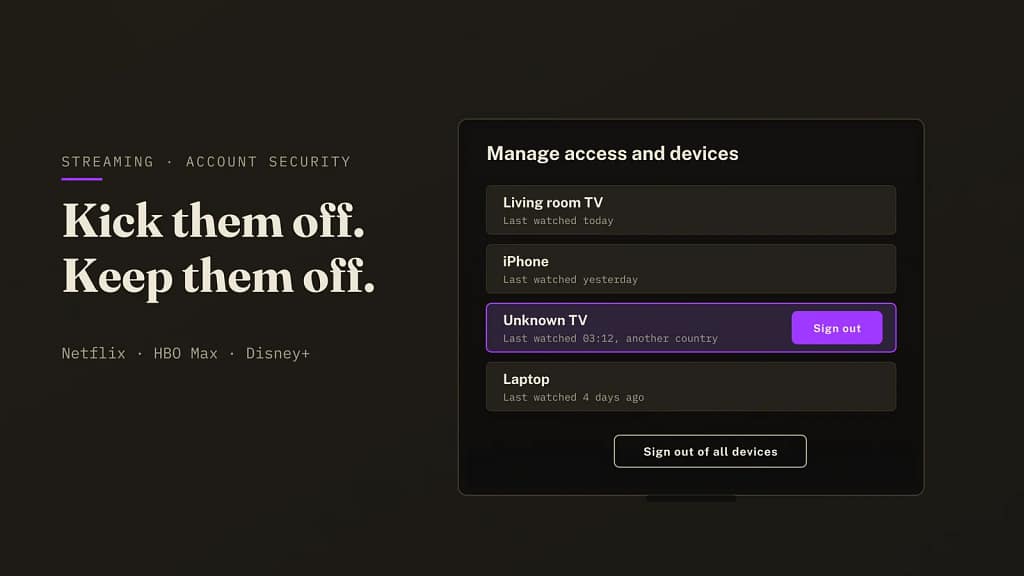
Not by peering through your curtains, unfortunately, though at this point I wouldn’t entirely rule it out. HBO Max’s own terms of service reserve the right to use your IP address, your device ID, and your account usage data together to figure out whether you actually live where you claim to. That combination is the real machinery behind HBO Max cracking down on sharing, three signals working together rather than one, which is the whole reason a VPN alone doesn’t fix this.
According to reporting from FlatpanelsHD, your household gets anchored to your home television. Fair enough. But mobile devices have to stream something, even a couple of minutes, on that same home Wi-Fi network at least once every 90 days to stay recognised as part of the household. Forget to do that and your own phone starts looking like an outside device, even though you’ve never shared your login with a soul.
Which is genuinely maddening if you think about it for more than ten seconds. You can be the most boring, single-household, never-shared-a-password-in-your-life subscriber and still get flagged, purely because your phone hasn’t touched the home Wi-Fi in three months. Meanwhile someone spoofing a US IP from another continent can sail through, provided their device ID and usage pattern look tidy enough. There’s no justice in it.
Why does everyone else still blame VPN blocking?
Laziness, mostly, and I say that as someone who has been guilty of exactly this on other articles before I actually checked. Early streaming geo-restriction really was mostly IP blacklisting, so writers took that model, HBO Max blocked something, therefore VPN, and never updated it once the underlying system changed.
Netflix moved first with its Household system, built on device ID and IP matching rather than a straightforward blacklist, and HBO Max has followed something close to that playbook rather than reinventing the wheel. The “just switch VPN servers” advice clogging up page one of Google is roughly two generations out of date. It was decent advice, in 2021. There’s similar VPN confusion over on YouTube, where a totally different platform gets blamed on the wrong VPN provider entirely. Wrong villain, same lazy plot.
What annoys me most is the cost this has to actual people. Someone spends forty minutes cycling through VPN servers trying to fix a problem their VPN never caused in the first place, because some article told them to. Your telly hasn’t moved house. The verification system doesn’t care which server you’re connected to if your device and usage history don’t match.
Does the “I’m traveling” feature still work?
Yes, and it’s the single most underused thing HBO Max actually built for you. If you searched something like HBO Max I’m traveling to land on this page, you’re in the right spot, and it’s a bit bizarre that nobody talks about this feature enough given it’s sitting right there in the app. The account owner, or anyone genuinely living with them, can select “I’m Traveling” from the TV device they’re using, and HBO Max sends a one-time code to the email on the account.
For actual travel it does exactly what it says on the tin. Message pops up, you’re away from home, you tap the option, check your inbox, type in the code, back to the football or whatever you’re watching. HBO Max also recommends streaming on your home network at least once a month to keep your status quietly ticking over in the background, which is a nice bit of housekeeping most people will forget to do.
There’s a limit though, and it’s not generous. Use “I’m Traveling” too often and HBO Max’s own support documentation basically says: hang on, if you haven’t been marking this yourself, someone else might be doing it on your account. Push it too far and the option can vanish entirely, which is exactly the mess I found people describing in HBO Max’s own support threads, two households, one confused subscriber, endless “I’m home” and “I’m traveling” toggling until the system gave up on both of them.
HBO Max VPN blocked vs household detection: two different problems
People lump these together constantly, and it’s one of the single biggest reasons the advice on HBO Max cracking down on sharing fails half the time.
VPN detection is when HBO Max spots your connection coming from a known VPN or proxy range, usually because you’re after content or pricing meant for somewhere you’re not. The message tends to mention regional availability specifically. Bit on the nose, that one.
Household detection is different. It’s your device ID, your usage history, your network fingerprint no longer matching what’s on file for your home, VPN involved or not. You’ll usually get the “subscribe today to keep streaming” prompt, or something about being marked as travelling too many times.
Read the actual error message. “Not available in your region” is location detection. “Keep streaming” or anything mentioning household updates is the device-ID system doing its thing. Reach for a VPN either way, like most guides tell you to, and good luck with that.
How to get around HBO Max location restrictions

If you typed how to bypass HBO Max household detection into a search bar to get here, the honest answer is that HBO Max’s terms of service are built around genuine household residence, and no VPN on earth changes your device ID or your actual viewing pattern, both of which now feed into how HBO Max is cracking down on sharing. A VPN by itself will not reliably beat household detection for any length of time, whatever some article written in 2024 is still telling you.
What a VPN is genuinely good for here is something else entirely. If you’re a real subscriber travelling and want your connection private on dodgy hotel Wi-Fi, or you want to poke around at pricing and catalogue differences before HBO Max has properly launched where you live, a decent VPN earns its keep. That’s a privacy and access job, not a household-spoofing job, and conflating the two is where a lot of this advice goes wrong. And if you’re going to run a VPN for exactly that reason anyway, there’s a proper recommendation coming up shortly, with the actual reasoning behind it rather than just a banner ad’s word for it.
For the household problem specifically, the tools that actually work are the ones HBO Max built for it. “I’m Traveling,” used within its limits, and the $7.99 extra member add-on if you need something permanent. Neither of them involves an arms race against a detection system that’s only going to get better at its job.
Step-by-step: fixing your specific issue
Work out which problem you’ve actually got first, because half the pain around HBO Max cracking down on sharing is people applying the wrong fix to the wrong problem. This matters more than anything else on this page. For the wider VPN and streaming picture once you’ve sorted the immediate issue, that’s worth a browse too.
If it’s a household verification issue (message mentions “keep streaming,” “traveling too many times,” or household updates):
- Check you’re signed in on the TV device registered as your actual home device.
- Get your phone or laptop onto your home Wi-Fi and stream a few minutes of anything, at least once a month, so your household status doesn’t go stale.
- Genuinely away from home? Select “I’m Traveling” on whatever device you’re using, and grab the one-time code from the email tied to the account.
- Option gone, or the code keeps failing? Contact HBO Max support directly rather than repeatedly toggling. Repeated toggling looks identical to their system whether it’s you doing it or someone else.
- Splitting time between two real homes on a regular basis? The $7.99 extra member add-on might genuinely be cheaper than fighting the household flag every few weeks. I say this with some sympathy, having done the fighting.
Different problem entirely, mind. If it’s a VPN or regional detection issue (message mentions region availability, not household):
- Turn off your VPN, proxy, or any DNS location trick entirely. All the way off.
- Restart your router. Some ISPs rotate IP addresses, and a stale one can trip a false flag for no good reason.
- Double-check HBO Max is actually live where you are right now. It launched in the UK and Ireland on 26 March 2026 and kept expanding across Europe, Asia-Pacific and Latin America through the year, so availability itself has been shifting under people’s feet.
- Need to check access while genuinely travelling somewhere HBO Max already operates? Pick a VPN server in that specific country, not a generic “streaming” server, and use a provider with an obfuscation protocol so the connection doesn’t scream “VPN” the moment it touches the network.
- Still flagged? Clear the app cache or reinstall it. Some smart TV apps hang onto an old IP-based region long after everything else has updated.
Best VPN for HBO Max in 2026: Proton VPN vs NordVPN
NordVPN is the name every single “best VPN for streaming” list defaults to, and to be fair, it’s earned some of that. Big server network, consistently decent speeds, Deloitte-audited no-logs claims. That’s a solid package and I’m not going to pretend otherwise. Never said it wasn’t. None of which, worth saying again, actually solves the HBO Max sharing crackdown problem on its own, since that’s a household issue rather than a pure VPN issue.
What NordVPN’s marketing conveniently skips past is jurisdiction. It’s based in Panama, which has no mandatory data retention law, genuinely fine as privacy positions go. Proton VPN sits in Switzerland instead, where Article 13 of the constitution offers an extra layer, and where Proton has, by its own transparency reporting, previously been asked for user logs and simply not had any to hand over.
Proton also ships its apps fully open-source on GitHub, and has now racked up five consecutive annual no-logs audits from Securitum plus a SOC 2 Type II audit, figures you can go and check yourself rather than take on faith.
| Dimension | Proton VPN | NordVPN |
|---|---|---|
| Jurisdiction | Switzerland (outside 5/9/14 Eyes) | Panama (outside 5/9/14 Eyes) |
| No-logs audit | Securitum, five consecutive annual audits, plus SOC 2 Type II | Deloitte, audited multiple times, most recent public certification through 2025-2026 |
| Obfuscation / stealth protocol | Stealth protocol, built to beat deep packet inspection | NordLynx (WireGuard-based), no separately marketed obfuscation protocol |
| Open-source apps | Yes, all clients on GitHub | No, closed source |
| Price (paid tier) | From roughly $2.99/month on a 24-month VPN Plus plan | From roughly $3.09/month on a two-year Basic plan |
| Honest limitation | Smaller server count than NordVPN, and no RAM-only server setup | Closed-source apps mean you’re trusting the audit summary rather than reading the code yourself |
That table looks close because the two services genuinely are close on paper. If it read as a total blowout in one direction I’d be suspicious of my own homework, frankly. The difference is what you’re actually optimising for, and I’ll admit Proton isn’t perfect either, the server count is smaller and support response times have occasionally been slower than I’d like when something’s gone sideways at an odd hour.
The Rundown
None of this, VPN or otherwise, gets you around genuine household verification if what you’re actually trying to do is permanently share an account with someone who doesn’t live with you. That’s not a bug to route around. That’s the entire point of the system WBD built, however inconvenient it is for your cousin’s Netflix-adjacent lifestyle. The honest options remain the extra member add-on, a separate account, or accepting that “I’m Traveling” is genuinely temporary and treating it that way. Whatever your feelings about HBO Max cracking down on sharing, that part isn’t changing.
Still, if you’ve already had that stomach-drop moment mid-episode wondering whether you’ve somehow been caught out for nothing, Proton VPN Plus is what actually takes the dread out of travelling with a shared login, because it does the legitimate privacy job properly instead of pretending it can outsmart a system that was never going to fall for it. Already juggling Proton Mail or Drive? Proton Unlimited folds the VPN into the same subscription, so you’re not maintaining a folder full of separate logins and privacy policies just to keep your digital life in one place.
HBO Max cracking down on sharing (FAQ)
Is HBO Max cracking down on sharing?
Yes, and it’s not a rumour or a one-off American thing anymore. Warner Bros. Discovery began testing password-sharing enforcement in the US in August 2025, and confirmed on its February 2026 earnings call that the HBO Max sharing crackdown would spread globally through the rest of the year. CEO JB Perrette called it the “second inning” of enforcement, which tells you it’s ramping up rather than finished. Most genuine subscribers getting flagged are actually running into household verification rather than being deliberately targeted, which is small comfort but worth knowing.
How does HBO Max know my household?
Its terms of service allow it to combine your IP address, device ID and account usage patterns to work out where you actually live, rather than relying on any single check. Your home television acts as the anchor, and other devices like phones need to stream something on your home Wi-Fi at least once every 90 days to stay counted as part of that household. It’s the combination that trips people up. VPN-only advice, the kind everywhere right now about HBO Max cracking down on sharing, only ever touches one of the three signals involved. Barely half the picture, really.
What happens if I tell HBO Max I’m traveling?
Selecting “I’m Traveling” on the device you’re using sends a one-time code to the email linked to your account, and entering it lets you carry on streaming while genuinely away from home. It’s a real feature built for real travel, not a loophole around the HBO Max sharing crackdown. There’s a limit on how often you can use it though, and lean on it too heavily and the option can disappear on you, so it’s meant as a temporary fix rather than a way to permanently dodge the household rules.
Can I lend my HBO Max to someone in a different house?
Not really, not within the terms anyway. Anyone who doesn’t live with the account owner, including family somewhere else like a college dorm, is expected to either get their own account or be added properly through the $7.99 monthly extra member add-on where it’s available. Handing over your login to someone outside the household risks the account itself getting flagged, which tends to be a far more annoying outcome than just paying the extra few quid. HBO Max cracking down on sharing this hard makes that maths pretty easy, if you ask me.
Why is HBO Max saying I’m using a VPN when I’m not?
Usually a false positive from shared or recycled IP addresses. Some ISPs, mobile networks and hotel or business connections use ranges that overlap with known VPN or proxy infrastructure, which can trip the same flag as an actual VPN even though you’re nowhere near one. Restarting your router for a fresh IP, or checking whether HBO Max has fully launched in your specific country yet, sorts this out more often than people expect. I’m not entirely sure this holds identically in every market, some regions seem twitchier about it than others, but it’s the first thing worth trying.
How do I bypass HBO Max household detection?
Honestly, there’s no reliable long-term way to dodge the HBO Max sharing crackdown within the rules, because the system checks device ID and usage pattern alongside your IP, and a VPN only ever touches the IP part. The legitimate routes are “I’m Traveling” for genuine travel within its limits, the official extra member add-on for $7.99 a month, or a separate account for anyone outside the household. Trying to trick the system risks losing the account entirely, which is a considerably worse outcome than just paying for the extra slot.
This article reflects HBO Max’s password-sharing enforcement and household verification system as understood in July 2026, while HBO Max continues cracking down on sharing across new markets. Warner Bros. Discovery has said enforcement will get more assertive through the rest of the year, and details may shift as the global rollout continues. Check HBO Max’s current help documentation before making decisions that affect your account access.
Some links on this page are affiliate links. If you sign up through them, BAIZAAR may earn a small commission at no extra cost to you. This supports the site and keeps the content free. Recommendations are based on genuine evaluation, not commission rates.