
Why People Click “Allow” in Seconds, The Psychology Behind Privacy Trade-Offs in Apps and Websites
Your data or your time?
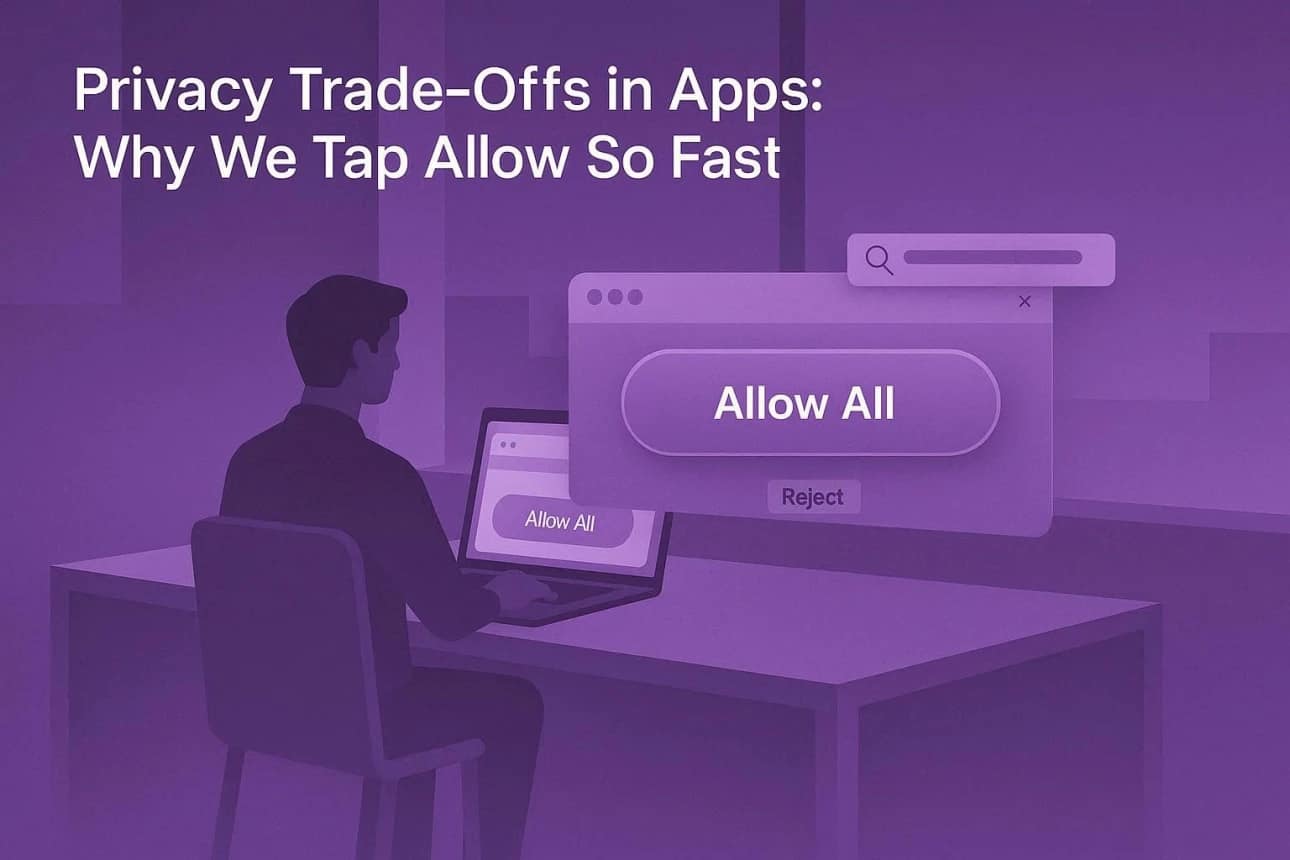
Last Tuesday, standing in Sainsbury’s (a grocery store for the americans) trying to scan a loyalty card, an app asked for my location. Not the postcode. My precise, real-time, GPS-tracked location. To scan a loyalty card. I tapped Allow without thinking, because I was also juggling a basket, my phone, and an internal debate about whether own-brand pasta is actually fine. It is, for the record.
That moment is what privacy trade-offs in apps actually look like in practice. Not some dramatic scene where a shadowy corporation asks you to sign over your soul. Just a Tuesday, a basket, and a reflex tap on a green button.
This article is about why that tap happens so easily, and what you can realistically do about it in 2026, when the prompts have genuinely multiplied.
(Quick one before we crack on: Baizaar does run a cookie policy because GDPR legally requires it for analytics and compliance. We fully support opting out, and our banner makes that straightforward. We’d rather be upfront about it than bury it where nobody looks.)
- Why Do We Accept Without Thinking?
- The Privacy Paradox Isn't You Being Lazy
- What Makes 2026 Worse Than 2025?
- Dark Privacy Patterns: When the Design Is the Problem
- Privacy Fatigue Is Real and Getting Worse
- Three Privacy Questions Worth Asking Before You Tap
- Tools That Shift the Default in Your Favour
- Privacy trade-offs in apps 2026 – Final note
- References & footnotes:
Why Do We Accept Without Thinking?
The short answer is that our brains are wired to take the thing that helps us right now over the thing that might protect us later. Psychologists call this hyperbolic discounting, which sounds like something from a physics lecture but basically means we’re rubbish at weighing abstract future risk against a concrete present reward.1
A Frontiers in Computer Science study found that people who genuinely care about their privacy still regularly hand over permissions on their smartphones, because the concern and the moment of decision rarely overlap. You care about privacy when you’re reading about it. You don’t care about it when you’re trying to find the nearest Pret in the rain.2
Apps are designed around this gap. Permission prompts don’t appear when you’re calm and reflective. They appear mid-task, when your attention is split and you just want the thing to work.
The Privacy Paradox Isn’t You Being Lazy
People call it a paradox because it looks contradictory. You say privacy matters, then you tap Allow, then you do it again tomorrow.
But it isn’t laziness. University of Toronto research across multiple countries found that clear, contextual explanations of why an app needs a permission actually do shift behaviour, which tells you the problem isn’t apathy, it’s the quality of information we’re given at the moment of decision. Most permission prompts are not clear or contextual. They’re vague, repeated, and formatted to be dismissed.3
We also tell ourselves we’ll sort it later. “I’ll revoke that in settings.” Spoiler: we don’t. And even when we do, device fingerprinting and prior consent mean a revoke doesn’t undo everything. Privacy isn’t a light switch you can flip back to zero.
What Makes 2026 Worse Than 2025?
By March 2026, the number of consent prompts most people encounter daily has increased, not decreased. Consent Mode V2, Global Privacy Control browser signals, and new US state privacy laws in California, Texas, Utah and Louisiana are theoretically good for users, but in practice they mean more banners, more layered choices, and more moments where tapping Accept is simply the path of least friction.4
European enforcement on cookie compliance has tightened, with over 35% of platforms still running non-compliant setups according to recent audits. The EU AI Act adds another layer, requiring more granular consent for profiling. Which means more prompts. Which means more fatigue.5
AI services specifically have added a new kind of pressure. Chatbots and recommendation engines ask for data to “personalise your experience” or “improve our models” in language that feels collaborative and reasonable, right up until you realise you’ve just consented to your conversation history being used for training. A 2026 study on chatbot trust found users regularly disclosed more than they intended before they’d even read the terms.6
Dark Privacy Patterns: When the Design Is the Problem
Here’s the bit that genuinely annoys me. A lot of fast consent isn’t just psychology. It’s deliberate, designed to manipulate us with behavioural science.
Dark patterns in consent flows are still widespread in 2026. Big green “Accept All” button, small grey “Manage Preferences” link buried below the fold, pre-ticked boxes for optional tracking, and a “Reject All” option that somehow requires three more clicks than accepting. The FTC in the US has started targeting some of these, and EU GDPR enforcement has fined platforms for making opt-out deliberately harder than opt-in. But enforcement is inconsistent, and the patterns persist because they work.7
Familiarity makes it worse. When you’ve seen the same style of consent banner two hundred times, your brain files it as routine and harmless. You stop reading. You start clicking. That’s not carelessness, that’s your cognitive system doing exactly what it was built to do with repetitive, low-stakes-seeming stimuli. The issue is the stimuli aren’t actually low stakes.
Privacy Fatigue Is Real and Getting Worse
Privacy fatigue is the state of being so worn down by constant data requests that you simply give up engaging with them. Research published in Nature tracked the specific triggers, including information overload, low perceived control, and the sense that individual choices don’t matter anyway, and found they all compound each other.8
I feel this personally on news apps. Every time I open one I haven’t used in a while, there’s a consent banner, then a push notification request, then an “improve our coverage” survey, then an ad-personalisation pop-up. By the time I reach the article I actually came for, I’ve tapped through four screens. None of which I read. That isn’t informed consent. That’s friction management.
The WhatsApp “Careless Whisper” vulnerability from earlier this year is worth flagging here too. Even encrypted apps can leak metadata in ways users never consented to, which is a reminder that fast permissions carry longer consequences than they appear to. We covered exactly that one here.
Three Privacy Questions Worth Asking Before You Tap
You’re not going to read every privacy policy. Nobody does, and honestly, some of them are written specifically to discourage it. But there are three questions worth running through in the five seconds before you tap Allow:
- What data is actually being requested? Location is different from contacts, which is different from microphone access.
- Does the app need this to function, or does it want it for tracking and ad targeting? There is a meaningful difference and it’s usually obvious once you ask.
- What happens if I say no? In most cases, the core app still works. Maps without precise location still gives you directions. News apps without push notifications still have news.
That last question matters most. Fear of losing functionality drives a lot of unnecessary acceptance. Most of the time, the feature you actually want works fine with limited or no access.
Tools That Shift the Default in Your Favour
I’ll be straight with you: personal habit changes alone won’t fix structural problems in consent design. They won’t, and anyone who says otherwise is shilling half-baked dreams. But some tools genuinely shift the privacy default without asking you to give up much functionality, and I’ve used these rather than just listing them because they look good on a page.
For email: If you’re on standard Gmail, your inbox is being scanned for advertising signals. I moved to Proton Mail a couple of years ago. End-to-end encrypted, free tier is genuinely usable day-to-day, and the privacy trade-off is effectively zero because there’s no ad model to feed. The mobile app is slightly clunkier than Gmail, I won’t pretend otherwise, but you stop noticing within a week, instead you start noticing the bliss that alias email / throwaways are as one of many practical features.
For inbox noise: SaneBox is worth a mention specifically because it filters your inbox by analysing email headers rather than content. It doesn’t read your emails to do its job, which for anyone bothered by AI tools parsing their messages is a meaningful distinction. I run it alongside Proton Mail and the combination cuts inbox noise considerably. The learning curve is mild and the time you get back is real.
For browsing on public wifi: Airports, cafes, hotel lobbies, anywhere you’re connecting to a shared network, a VPN is the simplest privacy default you can set. I use Proton VPN because it’s the same provider as my mail, their no-logs policy has been independently audited, and the speed is decent even on the free tier.
For task management: This one might surprise you, but Todoist is worth flagging on data handling. It doesn’t profile your task content for advertising and it isn’t feeding your deadlines and project names into a marketing model. For a tool you’re putting genuinely sensitive work into, that matters. I tested several apps for this specifically and Todoist came out well on data handling relative to the features you actually get.
None of these are perfect. Proton’s apps have the occasional rough edge. SaneBox takes a week or two to learn your patterns. Todoist’s natural language input is good but not magic. But each one shifts a privacy trade-off in your direction without requiring you to become a monk about technology.
FAQ: Privacy Trade-Offs in Apps
Is tapping Allow the same as informed consent?
Technically a fast tap can be legally valid while still being rushed, confusing, or shaped by friction. Valid and informed aren’t the same thing.
Why do smart people accept intrusive permissions?
Because time pressure and habit operate independently of intelligence. Most permission decisions happen mid-task, not during calm reflection.
Are personalised features always a bad privacy trade-off?
Not always. Limited, relevant, reversible data sharing can be a fair exchange. The problem is when the scope is vague, excessive, or practically impossible to walk back.
Do private browsing and clearing cookies fix the issue?
They help with local traces and some basic tracking. They don’t address device fingerprinting, cross-site profiling, or consent already granted to a specific service.
Are dark patterns in consent design illegal in 2026?
Some are under active legal pressure, particularly where opt-out must be as easy as opt-in. Enforcement is inconsistent and varies by region.
Should I reject every permission prompt?
No. Location for maps, microphone for calls, camera for payments are legitimate requests. The goal is better judgement, not blanket refusal.
Does BAIZAAR use cookies?
Yes. GDPR requires it for legal compliance and analytics. We fully support opting out, and the banner on the site makes that easy. No hidden opt-ins.
Privacy trade-offs in apps 2026 – Final note
Privacy trade-offs in apps aren’t going away, not without drastic change and an evolution of global ethics or biological behavioural defaults. The consent infrastructure in 2026 is more complex than it was two years ago, and the psychological patterns that make us tap Accept fast haven’t changed at all. What can change is the quality of decisions you make within that system, and the tools you choose to reduce unnecessary exposure by default.
Next time you see “Allow”? Treat it as a trade-off. Not a “formality”.
References & footnotes:
- Bitforge. The Psychology Behind the Authorisation. https://bitforge.ch/en/the-psychology-behind-the-authorization/ (2025) ↩︎
- Frontiers in Computer Science. Smartphone App Privacy and Control Paradoxes (2022). https://www.frontiersin.org/articles/10.3389/fcomp.2022.986138/full ↩︎
- University of Toronto. Privacy Study Sheds Light on Why We Grant or Deny App Requests (2025). https://news.engineering.utoronto.ca/privacy-study-sheds-light-on-why-we-grant-or-deny-app-requests/ ↩︎
- CookieYes. Cookie Consent Trends (2026). https://www.cookieyes.com/blog/cookie-consent-trends/ ↩︎
- My Agile Privacy. Cookie Banner and Privacy Compliance: State of the Art in 2026. https://www.myagileprivacy.com/en/cookie-banner-and-privacy-compliance-the-state-of-the-art-in-2026/ ↩︎
- AI Regulation. You Trust Your Chatbot With Everything. Should You? (2026). https://ai-regulation.com/you-trust-your-chatbot-with-everything-should-you/ ↩︎
- Cookie Script. Dark Patterns 2026: The FTC’s New Click-to-Cancel Rule. https://cookie-script.com/privacy-laws/dark-patterns-2026-the-ftc-new-click-to-cancel-rule ↩︎
- Nature Scientific Reports. Influencing Factors of Privacy Fatigue Among Users (2025). https://www.nature.com/articles/s41598-024-84646-z ↩︎