Proton Drive vs pCloud in 2026:
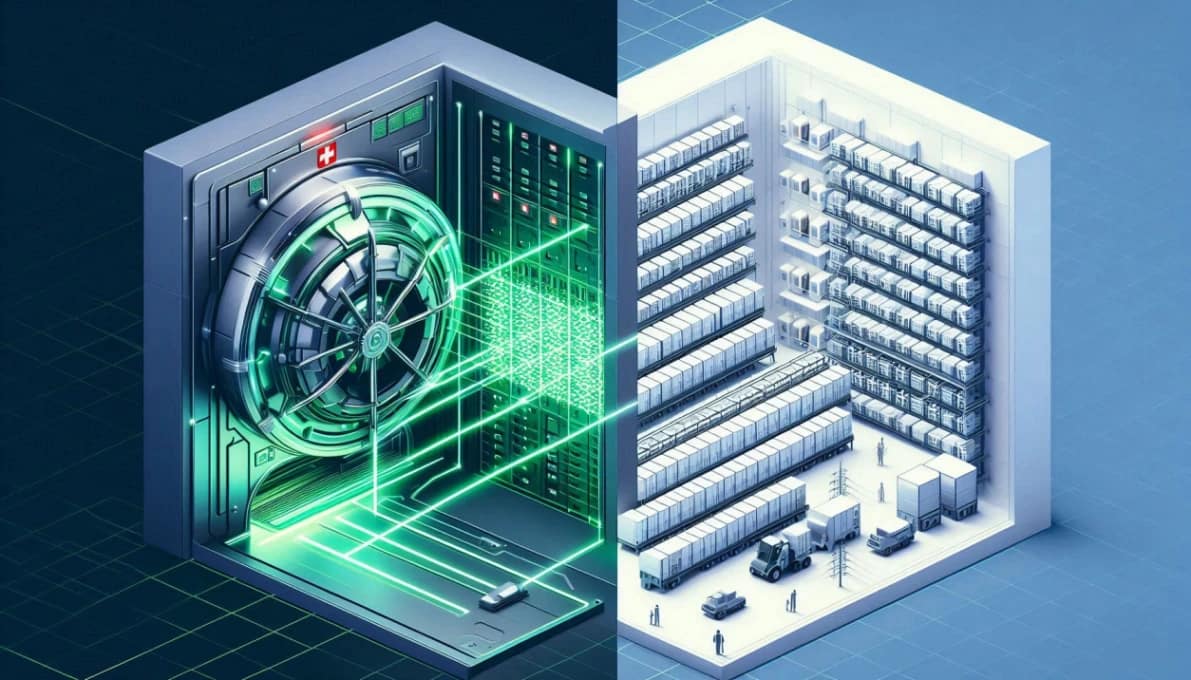
The “Vault vs. Warehouse” Cloud Strategy
By Baizaar Lee | Last Updated: 17 February 2026
Proton Drive vs pCloud: Quick Verdict
If you are torn between Proton Drive vs pCloud, you are asking a good question but the wrong way round.
You are not choosing a single winner; you are designing a two-layer cloud strategy:
- Proton Drive is your privacy-first vault for sensitive documents.
- pCloud is your capacity-first warehouse for huge file collections and long‑term backups.
For most privacy‑conscious users, the optimal setup in 2026 is:
- Proton Drive (Free or Proton Unlimited) for identity‑level data.
- pCloud Lifetime for bulk storage and creative workloads.
The rest of this Proton Drive vs pCloud comparison explains why.
- Proton Drive vs pCloud: Quick Verdict
- What Proton Drive Is Really For
- What pCloud Is Really For
- Proton Drive vs pCloud Security: Zero‑Knowledge vs Server‑Side Encryption
- Proton Drive vs pCloud Performance & Usability
- Proton Drive vs pCloud: Pricing & Value in 2026
- Business Case: When a GTM or Security Leader Needs Both
- Proton Drive vs pCloud: Feature Comparison Table (2026 Edition)
- Recommended Setup: Hybrid – A Simple 2-step Protocol
- Proton Drive vs pCloud FAQ (Tested, Real Questions)
- Is Proton Drive safer than pCloud for legal or medical documents?
- Does pCloud log or scan my files?
- Can Proton Drive replace Google Drive or Dropbox entirely?
- Is the pCloud Lifetime plan sustainable long term?
- Does Proton Drive support file version history?
- Which is better for sharing large files with clients: Proton Drive or pCloud?
- Can I mount Proton Drive or pCloud on a Linux server for backups?
- How does Swiss jurisdiction affect Proton Drive vs pCloud?
- Which should I pick if I only want one service?
- Final Thoughts: Proton Drive vs pCloud
- Sources
What Proton Drive Is Really For
Proton Drive: End‑to‑End Encrypted Cloud Storage
Proton Drive is an end‑to‑end encrypted cloud storage service built by Proton, the Swiss company behind Proton Mail and Proton VPN.1 It uses zero‑knowledge encryption by default:
- Files are encrypted on your device before upload.
- Proton cannot see your files or reset your password.
- If someone seizes Proton’s servers, they get meaningless ciphertext, not your documents.2
This makes Proton Drive ideal for:
- Scanned passports and ID documents.
- Contracts, pay slips, and tax returns.
- Medical records and therapy notes.
- Private notes, journals, and seed phrases (inside an encrypted container).
Proton Ecosystem Advantage
You are not just comparing Proton Drive vs pCloud in isolation. Proton’s Unlimited offering bundles:
- Proton Mail (encrypted email),
- Proton VPN (no‑logs Swiss VPN),
- Proton Pass (encrypted password manager),
- Proton Calendar (private calendar).
In practice:
- If you are de‑Googling your life, Proton Drive is the natural storage layer.
- One Proton Unlimited subscription covers email, VPN, passwords, calendar and storage.
Best current offer:
Get Proton Drive with Proton Unlimited (30% off deal)
What pCloud Is Really For
pCloud: Encrypted Cloud Storage with Lifetime Pricing
pCloud is a Swiss‑based cloud storage provider that offers standard encrypted cloud storage, optional client‑side encrypted folders via pCloud Crypto, and a unique Lifetime payment option.3
Where Proton Drive optimises for privacy, pCloud optimises for speed, media streaming, and long‑term cost efficiency.
pCloud is ideal for:
- 4K video archives,
- RAW photo libraries,
- Podcast/audio collections,
- Long‑term project backups and exports.
pCloud Lifetime vs Monthly Subscriptions
Most cloud providers rent you storage. pCloud lets you buy it.
Using typical public pricing:
- iCloud+ 2TB ≈ $9.99/month,
- Google One 2TB ≈ $9.99/month,
- Dropbox Plus 2TB ≈ $11.99/month,
- pCloud 2TB Lifetime ≈ $399 one‑off (often discounted in sales).4
Over 5 years, that works out as:
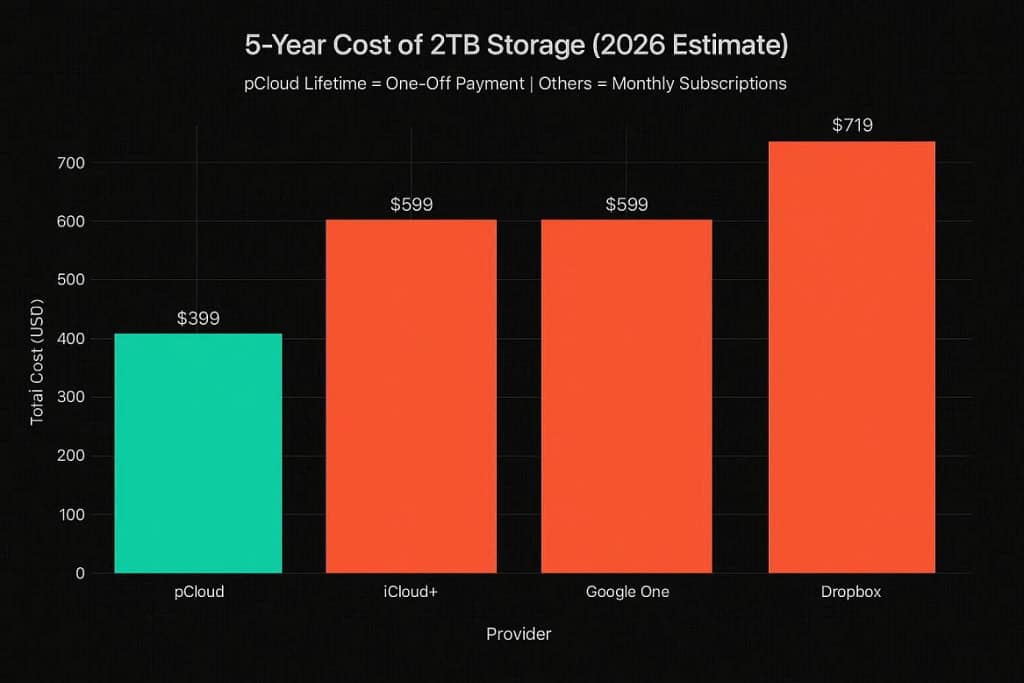
By year 3, the pCloud Lifetime deal has paid for itself. Over 5 years, you save $200-$320 compared to iCloud or Dropbox. We didn’t include Proton Drive, because Unlimited is cheaper and includes well a whole enterprise-grade privacy-suite.
pCloud’s Lifetime model outperforms iCloud, Google One and Dropbox financially after roughly 3 years. Do you plan to delete everything in 3?
Proton Drive vs pCloud Security: Zero‑Knowledge vs Server‑Side Encryption
How Proton Drive Handles Encryption
Proton Drive uses end‑to‑end encryption with client‑side key management:
- Keys are derived from your password and never sent to the server unencrypted.
- Proton staff cannot decrypt your files even if they want to.
- Proton operates under Swiss data protection laws (FADP), which are stricter than many EU and US regimes.5
Upside: Maximum privacy and strong legal protection.
Downside: If you lose your password and recovery methods, your data is unrecoverable.
This is why Proton Drive vs pCloud comparisons will always lean Proton for privacy‑critical use cases.
How pCloud Handles Encryption
By default, pCloud uses server‑side encryption:
- Files are encrypted at rest on their servers.
- pCloud holds the encryption keys to allow previews, thumbnails, and fast search.
- pCloud complies with Swiss data‑protection law and claims no data mining.
For users who want Proton‑style privacy, pCloud offers pCloud Crypto:
- A special folder where encryption keys never leave your device.
- Files in Crypto are zero‑knowledge; even pCloud cannot decrypt them.
However, Crypto costs extra and is one folder separate from the rest of your file tree.
Balanced view:
- Proton Drive gives you zero‑knowledge everywhere automatically.
- pCloud gives you speed and convenience by default, with the option to upgrade specific folders to zero‑knowledge.
Proton Drive vs pCloud Performance & Usability
pCloud Drive: Virtual Drive & Media Streaming
pCloud’s desktop client creates a virtual drive:
- You see your entire cloud as if it were an external hard drive.
- Files do not consume local space until you open them.
- When you edit large files, pCloud updates only the changed blocks (block‑level sync).6
pCloud also includes a built‑in video player with adaptive streaming and audio playlists for music collections.
Result: pCloud is excellent as a personal media server or a remote project drive for video editors.
Proton Drive UX: Cleaner, Simpler, Less Flashy
Proton Drive is more conservative in features:
- Web‑based interface with simple folder navigation,
- Desktop apps rolling out gradually,
- Focus on predictable, audit‑friendly behaviour rather than clever tricks.
You can store and share documents securely, generate encrypted sharing links, and use Proton Drive as part of an encrypted Proton Mail workflow.
What you cannot yet do as smoothly is stream 4K video directly in the browser or mount Proton Drive as a high‑performance virtual disk for editing.
Balanced view:
- For everyday productivity documents, Proton Drive feels clean and calm.
- For heavy media work, pCloud still feels faster and more flexible.
Proton Drive vs pCloud: Pricing & Value in 2026
Proton Drive & Proton Unlimited Pricing
Proton offers a free tier with limited storage (enough for critical documents) and paid plans where Proton Unlimited bundles Mail, VPN, Pass, Calendar and Drive at a discount.
From a business and GTM perspective, if you need private email and VPN anyway, Proton Unlimited gives you encrypted storage almost “for free.”
De-Google your entire life in one subscription..
Lock in Proton Unlimited →(Reader Exclusive: 30% Off )
Get Proton Mail, VPN, Drive, Pass & Calendar the privacy singularity-hub of encryption, all Swiss, 30% off Proton Unlimited here.
pCloud Lifetime Value
pCloud’s value is easier to express in spreadsheets:
- One pCloud Lifetime purchase can replace years of recurring payments to Google, Apple or Dropbox.
- For large data hoarders (creators, photographers, OSINT collectors), the savings become dramatic by year 5.
Because pCloud does not bundle email or VPN, it rarely replaces Proton; it replaces generic big‑tech storage.
Stop paying monthly rent on your own data.
Grab the pCloud Lifetime deal and own your storage forever →
One payment. No subscriptions. No rising cost YoY perpetually renting a depreciating asset in someone else’s data centre.
Business Case: When a GTM or Security Leader Needs Both
For a GTM lead or security‑aware founder, a mature stack in 2026 might look like:
- Proton Suite for Identity & Communications
- Proton Mail for sales and personal email,
- Proton Pass for shared account management,
- Proton VPN for travel and untrusted networks,
- Proton Drive for contracts, customer data snippets and strategic docs.7
- pCloud Lifetime for Operational & Creative Assets
- All call recordings, raw podcasts, screen‑share training videos,
- Marketing assets, design exports, screenshot archives,
- OSINT data dumps, scraped datasets and webinar recordings.8
Proton Drive vs pCloud: Feature Comparison Table (2026 Edition)
| Dimension | Proton Drive | pCloud |
|---|---|---|
| Primary role | Secure document vault | High‑capacity media warehouse |
| Default encryption | End‑to‑end, zero‑knowledge | Server‑side (keys held by pCloud) |
| Optional zero‑knowledge folder | Built‑in everywhere | Available as paid pCloud Crypto add‑on |
| Pricing model | Subscription (often bundled with Mail/VPN/Pass) | Lifetime purchase or subscription |
| Media streaming | Basic previews | Full video & audio streaming |
| Virtual drive support | Emerging | Mature pCloud Drive virtual disk |
| Linux support | Web focused | Full GUI & CLI clients |
| Ideal user | Privacy maximalists, professionals with sensitive data | Creators, hoarders, backup and archive heavy users |
Recommended Setup: Hybrid – A Simple 2-step Protocol
To keep this actionable, here is a tested, realistic setup you can copy.
Step 1: Classify Your Data
Split your files into three buckets:
- Identity & Legal Risk – Anything that could be used to impersonate you or expose private health or financial details.
- Operational & Creative – Assets you need to work with frequently: slides, videos, large docs.
- Cold Archive – Things you do not need often but never want to lose (e.g. old campaigns, personal memories).
Step 2: Map Each Bucket to a Service
- Bucket 1 → Proton Drive
Store ID scans, contracts, tax exports, sensitive strategy documents in Proton Drive. Share only via Proton links or Proton Mail attachments. - Bucket 2 → pCloud Drive
Store large project folders, video footage, design assets in pCloud. Work on them directly through the virtual drive. - Bucket 3 → pCloud + External Backup
Use pCloud for offsite redundancy and a local drive or NAS for quick access.
Optional hardening: For semi‑sensitive large files in pCloud, run them through Cryptomator before upload to get client‑side encryption without paying for Crypto.
Proton Drive vs pCloud FAQ (Tested, Real Questions)
Is Proton Drive safer than pCloud for legal or medical documents?
Yes. Proton Drive uses end‑to‑end zero‑knowledge encryption by default, meaning Proton cannot decrypt your files and cannot hand your data to third parties in readable form. pCloud can offer similar protection only inside the optional Crypto folder; standard folders use server‑side encryption where pCloud controls the keys.
Does pCloud log or scan my files?
pCloud states that it does not inspect user files for advertising, but it does process them to create thumbnails, previews and metadata for search. This is only possible because pCloud’s servers can temporarily access unencrypted content for standard folders.
Can Proton Drive replace Google Drive or Dropbox entirely?
For many knowledge‑work teams, yes. Proton Drive can replace Google Drive or Dropbox for documents, spreadsheets, PDFs and shared folders, especially when combined with Proton Mail for collaboration. For highly media‑heavy workflows (video editing, large design projects), Proton Drive still feels slower than specialised storage like pCloud.
Is the pCloud Lifetime plan sustainable long term?
Independent reviews and user reports across several years suggest that pCloud’s Lifetime plans are genuine and have remained honoured. The risk is not zero – no company is immortal – but pCloud has operated since 2013 under Swiss jurisdiction without major scandals.
Does Proton Drive support file version history?
Yes. Proton Drive supports file version history, letting you restore previous versions of documents or recover from accidental changes. pCloud also offers versioning and a “Rewind” feature that can roll back your whole account to a previous date for a limited retention period.
Which is better for sharing large files with clients: Proton Drive or pCloud?
If the files are sensitive or confidential, Proton Drive is better because share links are encrypted and can be password‑protected with zero‑knowledge guarantees. If the files are huge media exports for clients who care about convenience more than privacy, pCloud’s branded download links and faster streaming often provide a smoother experience.
Can I mount Proton Drive or pCloud on a Linux server for backups?
pCloud provides official Linux clients and documented support for command‑line usage, which works well with server backup scripts. Proton Drive is primarily web‑focused; while community tools exist, Proton’s own documentation emphasises desktop and web clients over server integration.
How does Swiss jurisdiction affect Proton Drive vs pCloud?
Both Proton and pCloud operate under Swiss data protection law (FADP), which requires strict handling of personal data and strong safeguards for privacy. The main difference is architectural: Proton cannot decrypt your data without your keys, while pCloud can decrypt standard folders if legally compelled.
Which should I pick if I only want one service?
If you care more about privacy and secure communication than raw storage volume, choose Proton Drive as part of Proton Unlimited and keep using external drives for large media. If you mainly need somewhere cheap and reliable to park terabytes of non‑critical files, pCloud Lifetime is hard to beat on value.
Final Thoughts: Proton Drive vs pCloud
From an BAIZAAR’s perspective, the answer is never as simple as one hopes for but an answer nonetheless:
“Proton Drive vs pCloud is not a binary choice; it is a layered security and storage decision.“
- Proton Drive storms ahead with privacy: end‑to‑end encryption, Swiss jurisdiction, secure communications.
- pCloud leads in capacity and cost: lifetime storage, virtual drive, media streaming (also Swiss-based!)
BAIZAAR’s stance, grounded in real‑world use and cross‑tool stacks, is simple:
- Put secrets in Proton.
- Put bulk in pCloud.
- Avoid renting storage forever from “big‑tech” when you can own it once.
Proton Offer: Get Proton Drive & Proton Unlimited with 30% off (Reader Exclusive)
pCloud Offer: Check pCloud Lifetime pricing and offers
Both links are affiliate links; they cost you nothing extra and help fund more brutally honest, paranoia‑friendly reviews.
Sources
- Proton AG, “Privacy by Default” – Proton.me ↩︎
- Proton Drive, “Zero-Knowledge Encryption Explained” – Proton.me/drive/security ↩︎
- pCloud, “Swiss Privacy Laws and Business Security” – https://blog.pcloud.com/why-choose-pcloud-for-business-over-us-giants/. ↩︎
- pCloud, “What is pCloud Lifetime?” – https://www.pcloud.com/help/general-help-center/what-is-pcloud-lifetime ↩︎
- Swiss Federal Data Protection & Information Commissioner, “Federal Act on Data Protection (FADP)” – https://www.edoeb.admin.ch/en/18112024-the-new-data-protection-act-in-figures. ↩︎
- pCloud, “Synchronization and Backup Features,” – https://www.pcloud.com/features/synchronization.html ↩︎
- BAIZAAR, “Why Proton Mail is the Only Inbox I Trust” – https://baizaar.tools/proton-mail-encrypted-email-the-inbox-i-trust-2026/. ↩︎
- BAIZAAR, “Best Cloud Storage for Privacy 2026,” – https://baizaar.tools/best-cloud-storage-for-privacy-2026/ ↩︎