Why Proton Mail Encrypted Email is the Inbox I Trust in 2026 (Authentic Privacy)
What End-to-End Encryption Actually Means (Without the Technobabble)
I didn’t fully appreciate the value of proton mail encrypted email until I realized how much data Gmail was collecting about me. In this article, I’ll explain why proton mail encrypted email has become the only inbox I trust for sensitive communications.
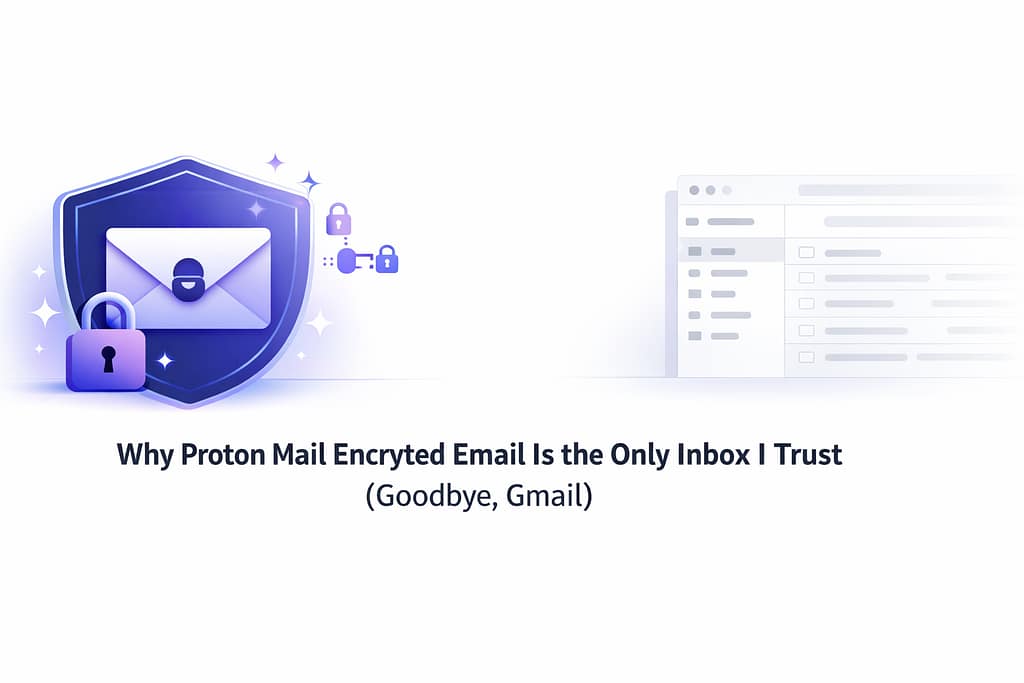
Proton Mail encrypted email works like a locked briefcase that only two people hold keys to. You write your message, Proton locks it with your recipient’s unique key before it ever leaves your device. The message travels through the internet completely scrambled. Your email provider (Proton) can’t read it. Governments can’t read it. Hackers who intercept it mid-transit can’t read it. Only the person with the matching private key can unlock and read what’s inside. This is called end-to-end encryption, and it’s the fundamental reason why people who’ve been surveilled, threatened, or simply exhausted by tech companies’ data extraction are abandoning Gmail in droves.
The distinction matters: Gmail encrypts your emails in transit (between servers) and at rest (on their servers), but Gmail itself holds the decryption keys. If Google receives a court order, they hand over your readable emails. If a disgruntled Google employee turns malicious, they access your plaintext messages. If Google’s infrastructure is breached, attackers get intelligible data. With Proton Mail’s zero-access encryption, none of these scenarios apply because Proton literally cannot decrypt your messages even if it wanted to.
According to research from the Electronic Frontier Foundation, a leading independent authority on digital privacy rights, “end-to-end encryption is the gold standard for protecting communications from surveillance.” This is precisely why Proton Mail Encrypted Email and it’s particular architecture represents a genuine paradigm shift in email privacy.
How Zero-Access Encryption Actually Protects You
Proton Mail uses a hybrid cryptographic approach that sounds complex but is genuinely elegant:
For emails between two Proton Mail Encrypted Email users:
Your message is encrypted on your device using the recipient’s public key before transmission. Proton’s servers receive already-encrypted data. They store encrypted data. The recipient decrypts locally on their device. Proton never sees the plaintext.
For emails from Proton Mail to non-Proton users:
By default, these travel encrypted via TLS (industry standard), but because the recipient doesn’t have a Proton account, TLS encryption is sufficient—not end-to-end. However, you can use Proton’s Password-Protected Emails feature, which forces end-to-end encryption even when sending to Gmail or Outlook users. The recipient receives a secure link and must enter a password you’ve shared separately to decrypt the message.
For incoming emails from non-Proton users:
Gmail or Outlook sends your message unencrypted to Proton’s servers. The moment it arrives, Proton encrypts it using your public key. From that point forward, the message is encrypted at rest and can only be decrypted by you with your private key.
The technical foundation relies on AES-256-GCM (Advanced Encryption Standard with 256-bit keys) for symmetric encryption and elliptic curve cryptography (ECC) based on OpenPGP standards for key management. This isn’t theoretical security theater—independent security audits* have validated the implementation. *All sources found at bottom of the article
The “Gmail Integration” Hybrid Approach: Degoogling Without Sacrificing Functionality
Here’s a reality: You can’t fully escape Gmail overnight. You might have years of emails, critical accounts tied to Gmail authentication, and colleagues who only know your Gmail address. So instead of a complete break, consider a hybrid degoogling strategy that uses Proton Mail encrypted email inbox as your primary while strategically managing Gmail’s remaining exposure.
How to Implement Smart Gmail Integration
Primary Strategy: Use Proton Mail Encrypted Email exclusively for new communications, but keep Gmail for legacy accounts and services requiring Gmail recovery options.
Proton Mail Bridge + Gmail Monitoring:
Set up Proton Mail Bridge on your primary device and configure it to forward a copy of all Gmail receipts to your Proton account (via a filter rule). This way, you can:
- Send and receive from Gmail addresses using Proton’s encrypted infrastructure via Bridge
- Maintain access to existing Gmail services without switching
- Monitor Gmail for account recovery attempts or suspicious activity
What Proton Mail’s Security Features Actually Protect Against (That Gmail Doesn’t)
Proton Mail encrypted email implements several real privacy features beyond encryption that Gmail either doesn’t offer or actively avoids:
1. Tracking Protection and Link Redirection Removal:
Gmail scans your inbox content to build behavioral profiles. It also scans URLs you click to track behavior across the web. Proton Mail doesn’t do either. When you click links in Proton Mail, they go directly to the destination, no interception, no tracking pixel injection, no profile building. This is a non-trivial security advantage: your clicking patterns remain private, not analyzed by advertisers.
2. Image Proxy and Pixel Tracking Removal:
Gmail loads externally hosted images on the server side, which allows image senders to see when you opened an email (read receipts) and your location (via IP). Proton Mail encrypted email blocks external image loading by default, preventing this tracking entirely. For journalists, activists, or anyone communicating with potential threats, this prevents confirmation of identity or location based on email opens.
3. Additional Layer of Sender Verification:
Proton Mail validates sender authentication protocols (SPF, DKIM, DMARC) more strictly than Gmail. Emails that fail these protocols are flagged prominently, reducing phishing risks. Gmail applies these standards more loosely, prioritizing convenience over security.
4. No AI-Powered Content Scanning:
Google has admitted Gmail uses machine learning to scan email content for training data and advertising purposes. Proton Mail encrypted email has a strict no-scanning policy. Your email content stays private—not fed into any AI training pipeline, not analyzed for ad targeting, not examined for behavioral profiling.
5. Completely Open-Source, Auditable Architecture:
Unlike Gmail’s proprietary infrastructure, Proton Mail’s code is open source. Security researchers worldwide can inspect it for vulnerabilities. While Gmail undergoes internal Google security audits, Proton Mail undergoes independent third-party audits published publicly. For security-conscious users, transparent inspection beats corporate assurance every time.
The Features That Actually Matter & Why I Switched to Proton Mail Encrypted Email
Proton Mail Bridge: Desktop Email Client Freedom
Proton Mail Bridge is the unsung hero for power users who refuse to live inside a web browser. It’s a free tool that decrypts your emails locally on your device, then feeds them to Thunderbird, Outlook, Apple Mail, or Evolution. You get full end-to-end encryption and the desktop email client you prefer. The catch: Bridge is only available on paid plans, and you need to install it on each device.
This matters because it means you’re not locked into Proton’s interface if you don’t want to be. You can use Proton’s security architecture with whatever email client feels most natural to you. Additionally, for users wanting to maintain legacy Gmail accounts alongside Proton, Bridge enables this hybrid workflow seamlessly.
Ready to test Proton Mail Encrypted Email Plus with Bridge on your preferred desktop client? Start your privacy-first future today with Proton Mail Plus (reader exclusive discount link!) click here.
$3.99/month (pre-discount) when billed annually. 30-day money-back guarantee if it doesn’t fit your workflow.
Calendar and Drive Integration
Proton Mail Plus and above include encrypted calendar access (up to 20 personal calendars with link-based sharing) and Proton Drive integration (secure file storage shared across your Proton account). These aren’t marketing fluff—they’re genuinely encrypted alternatives to Google Calendar and Google Drive. This is where Proton Mail becomes a complete privacy suite. You’re not just encrypting emails; you’re removing yourself from Google’s entire surveillance ecosystem.
Calendar invitations work via link-sharing for non-Proton users, maintaining encryption. Drive lets you share encrypted files with password protection.
Password-Protected Emails to External Recipients
Send encrypted messages to anyone—even non-Proton users—via secure link. The recipient enters a password and reads the message through a Proton portal. End-to-end encrypted, even to Gmail.
Advanced Search (Local Only)
Here’s where the architecture bites back. Because Proton’s servers don’t store plaintext versions of your emails, server-side search is impossible. However, Proton Mail’s web app generates a local encrypted search index on your device when you login. You can search email bodies, subjects, and senders—but only for emails already downloaded to your device.
On mobile, search is currently limited, though Proton has announced expansions to this feature.
Catch-All Emails and Multiple Aliases
On paid plans, you can receive mail sent to any address under your custom domain and automatically have it routed to your inbox. This is essential for anyone building an online presence without compromising their primary inbox. Paired with strong password management (as discussed in our comprehensive password manager guide), multiple aliases become a powerful privacy architecture.
Open Source and Independently Audited
Proton Mail’s apps are open source, meaning security researchers globally can inspect the code for vulnerabilities. The company commissions annual third-party security audits, publishing detailed reports. Most recently, Proton achieved SOC 2 Type II attestation (July 2025), an independent verification that security controls are rigorously implemented in practice, not just theory.
Where Proton Mail Encrypted Email Falls Short (The Honest Part)
No email provider is perfect. Anyone telling you otherwise is selling you a dream of cotton-candy land and forget, some individuals make it their full time job to speak in other languages than their native tongue, learned linguistics can now build rapport with employees and individuals at home to build trust and familiarity, before slowly ramping concessions of buy-in until bam they’ve sent you a meme via QR code.
1. Search Functionality is Crippled
This is the most legitimate criticism. Searching your inbox on mobile is nearly useless for large mailboxes. On the web, you can search content, but only if that content has been downloaded and indexed locally on your device. Multi-word searches, Boolean logic, and folder-tree searches don’t exist.
If you receive hundreds of emails monthly, searching for something from six months ago requires patience. You may need to resort to Thunderbird + Proton Bridge for genuinely powerful local search.
Why this exists: End-to-end encryption means Proton’s servers hold no plaintext to index. Server-side search would require Proton to decrypt your emails thus, defeating the purpose.
2. Subject Lines and Contact Information Aren’t End-to-End Encrypted
Proton encrypts email subjects and your contact database, but not with end-to-end encryption. Instead, they use zero-access encryption, which means Proton can’t read them but the architecture remains different from message bodies.
Why? End-to-end encrypted subject lines would break searchability entirely. You’d be unable to search your own inbox. Proton made a pragmatic trade-off: functional search at the cost of metadata encryption.
The threat model: If a government compels Proton to hand over metadata, they’ll see your contact names, email addresses, and subject lines. They won’t see message contents.
For most users, this is acceptable. For journalists, activists, or political dissidents, this is a legitimate weakness.
3. Limited Free Plan Storage
The free tier includes only 1GB of storage, 1 email address, and a 150-email-per-day sending limit. This forces most active users onto paid plans quickly. For comparison, Gmail gives 15GB free.
4. Integrations Are Minimal Compared to Gmail
Proton Mail Encrypted Email due to privacy-first design doesn’t integrate with thousands of third-party apps like Gmail does via Zapier or native connectors. You can use IMAP/SMTP (via Bridge on paid plans) to connect to many tools, but it’s not seamless. If you rely heavily on automation (Zapier workflows, IFTTT, custom integrations), Gmail or Microsoft 365 remain superior.
For organizations using our top secure password managers, Proton Mail’s limited integrations become less problematic since many workflows can be secured through other channels.
5. Desktop Client Support Is Limited
Proton Mail doesn’t offer an official native Mac or Windows app (as of January 2026, a beta exists, but it’s not production-ready). You’re restricted to web interface or Bridge + third-party clients. Gmail, Outlook, and Thunderbird all have mature desktop apps.
6. Account Blocking Without Appeal Process
Some users report Proton Mail accounts being frozen without clear explanation or refund process. This is rare, but it’s a legitimate complaint worth mentioning. If you’re relying on Proton for business-critical communication, understand the risk.
Proton Mail vs. Proton Free vs. Gmail: The Honest Comparison
| Feature | Proton Mail Free | Proton Mail Plus | Gmail (Free) |
|---|---|---|---|
| Storage | 1GB | 15GB | 15GB |
| Email Addresses | 1 | 10 | 1 |
| End-to-End Encryption | Yes, default | Yes, default | No |
| Server-Side Search | No, local only | No, local only | Yes, full-text search |
| IMAP/SMTP Support | Email access only | Yes, via Bridge | Yes (free) |
| Password-Protected External Emails | Yes | Yes | Limited options |
| Calendar Included | No | Yes, encrypted | Yes, via Google Calendar |
| File Storage Included | No | Yes, encrypted | Yes, via Google Drive |
| Daily Email Limit | 150 emails/day | Unlimited | Unlimited |
| Cost (Monthly) | Free (limited) | $4.99 ($3.99/year)[ | Free (privacy is the product) |
| Surveillance Resistance | Proton can’t read emails; zero-access architecture | Proton can’t read emails | Google reads metadata and content for ad targeting |
| Source Code | Open source, audited annually | Open source, audited annually | Proprietary, not audited publicly |
| Jurisdiction | Switzerland (GDPR-compliant, no Five Eyes) | Switzerland (GDPR-compliant) | USA (Five Eyes member, NSA requests) |
| Metadata Privacy | Partial (subjects/contacts use zero-access, not E2EE) | Partial (subjects/contacts use zero-access) | Minimal; Google mines extensively |
| Third-Party Integrations | Limited | Limited | Extensive (thousands via Zapier) [ |
| Desktop App Support | Web-only | Bridge + third-party clients | Native app (all platforms) |
| Phone Support | Community forums only | Email-based support | Community forums; limited direct |
| Search Quality | Poor on mobile, functional on web (local only) | Poor on mobile, functional on web | Excellent, real-time. |
| VPN Integration | No | Optional upgrade | No |
| Mobile App Quality | Full-featured | Full-featured | Full-featured |
If you’re looking to upgrade from Proton Free to Plus and unlock Bridge + Calendar + Drive, the annual plan works out to just $3.99/month. Most users find the extra storage, multiple aliases, and desktop client access immediately justify the investment.
The Trust Argument: Why Surveillance is Real
Let’s be direct. If you’re reading this, you’re probably not paranoid.. you’re aware. Between Cambridge Analytica, the Pegasus spyware revelations, NSA bulk data collection (exposed by Snowden), and the routine sale of location data to law enforcement, the assumption that your email is private is increasingly naive.
Gmail’s business model revolves around scanning your inbox to build targeting profiles. Google admitted it scans email to train AI models. They don’t hide this in the terms of service, it’s explicit. But most people don’t read the fine print.
Microsoft Outlook offers similar “conveniences”, cloud processing that requires server-side access to your plaintext emails.
Proton Mail Encrypted Email and its architecture is fundamentally different. Even if Proton wanted to read your emails, the mathematics wouldn’t allow it. Proton doesn’t hold the private keys that unlock your messages.
That’s not a marketing claim. It’s a technical reality validated by independent security audits.
For complete privacy beyond email, consider combining Proton Mail with a privacy-focused VPN. Our detailed VPN guide for 2026 explains exactly how to build a complete privacy architecture.
Should You Switch to Proton Mail?
Who’s likely to Consider Proton Mail Encrypted Email
You should consider Proton Mail if:
- You exchange sensitive information (medical details, financial records, legal documents, political views) regularly.
- You live in or communicate with people in countries with aggressive surveillance programs.
- You’re a freelancer or consultant handling client confidentiality.
- You distrust Big Tech companies philosophically.
- You need to send encrypted messages to non-technical recipients.
- You want email from a jurisdiction outside the Five Eyes alliance.
- You value open-source, audited security over convenience.
- You’re concerned about AI systems training on your email content without consent.
Gmail might remain superior if:
- You heavily automate workflows through third-party integrations.
- You need real-time full-text search across thousands of emails.
- You’re embedded in the Google Workspace ecosystem (Docs, Sheets, Meet, Calendar with native integration).
- You absolutely need native desktop clients without additional software.
- You’re in a jurisdiction where cloud computing via US providers is standard practice and you’re not handling classified information.
Pricing Breakdown: What You Actually Pay
Proton Mail Encrypted Email Free: 1GB storage, 1 address, 150 emails/day. Limited to web-only access.
Proton Mail Plus (Recommended for individuals – $4.99/month ($3.99/month annual, $3.49/month 2-year). 15GB storage, 10 email addresses, 1 custom domain, IMAP/SMTP access via Bridge, unlimited messages and folders.
Proton Unlimited (All-in-one for privacy-conscious power users) – $12.99/month ($9.99/month annual, $7.99/month 2-year). 500GB shared storage across Mail/Drive/Calendar, 15 email addresses, 3 custom domains, all Plus features, plus full Proton Drive and Calendar access, Proton VPN premium, Proton Pass unlimited logins. Enjoy the reader exclusive discount in the link above if you want to fully embrace the Proton Privacy ecosystem.
Proton Family: $29.99/month. Up to 6 users, 3TB total storage, all Unlimited features for each user.[52]
Business Plans: Mail Essentials ($7.99/user/month), Business ($12.99/user/month), Enterprise (custom).
If you’re paying with privacy, Gmail is cheaper. If you value your data not being sold to advertisers or handed to governments, Proton Unlimited is among the best investments you can make.
The Setup: What to Expect
(from Daily Use Experience with Proton Mail Encrypted Email)
- Sign up. Use a strong, unique password (or generate one via a password manager). Proton doesn’t require a phone number, though you can add one for account recovery.
- Set recovery method. Add a recovery email (can be external) or recovery phrase. Don’t skip this as account recovery without these is difficult.
- Import existing mail (optional). Use Proton’s “Easy Switch” tool to import from Gmail, Outlook, or other providers. Messages come over encrypted.
- Configure Bridge (if using desktop clients). Download and install on your computer. Configure Thunderbird, Outlook, or Apple Mail to connect via IMAP. All decryption happens locally.
- Enable two-factor authentication. Use an authenticator app (Authy, Microsoft Authenticator, or Proton Pass) instead of SMS. SMS is vulnerable to SIM swapping.
- Create aliases. If paying, set up additional email addresses for different purposes (work, personal, throwaway for spam). Each maintains complete separation in your inbox.
Final Verdict
Proton Mail encrypted email is the most pragmatic choice for anyone who’s woken up to the reality that email is surveillance infrastructure, not communication. It’s not perfect. Search is frustrating. Integrations are limited. Third-party app support lags behind Gmail.
But here’s the truth: Perfect is the enemy of good. Gmail is convenient and extractive. Proton Mail is slightly inconvenient and genuinely private.
For the cost of roughly a latte per month, you get an email provider that mathematically cannot read your messages. Even if served with a government order. Even if hacked. Even if compromised by insider threats.
That’s not paranoia. That’s rational security design.
Why Proton:
- Four-point-six star rating—thirty-nine thousand seven hundred reviews on App Store, four hundred fifteen thousand on Google Play
- Recommended by journalists and security experts worldwide
- Founded at CERN by scientists in Switzerland
- Open-source code and independently audited
- Over one hundred million users globally
- Strict no-logs policy verified by third-party security audits
Ready to try proton mail encrypted email? Start by setting up a free account and testing it alongside your current inbox.
Related Privacy Resources:
- See our Proton VPN review for complete network privacy
- Explore secure password managers to protect all your accounts
- Compare all privacy-focused email providers
Citations & Sources
The Email Toolbox. “How Does ProtonMail Implement End-to-end Encryption Technically?” (YouTube) (2025-11-03)
Cyfuture. “How Does ProtonMail Ensure End-to-End Email Encryption” https://cyfuture.cloud/kb/email/how-does-protonmail-ensure-end-to-end-email-encryption (2024-12-31)
The Email Toolbox. “How Does ProtonMail’s Zero-access Encryption Protect Your Email?” (YouTube) (2025-09-15)
Proton Mail. “Proton Mail encryption explained” https://proton.me/support/proton-mail-encryption-explained (2014-10-31)
The Email Toolbox. “How Does ProtonMail’s Zero-access Encryption Protect Your Email?” (YouTube) (2025-09-15)
TechRadar. “Proton reaffirms commitment to security in independent audit” (2025-07-23)
The Email Toolbox. “How Do ProtonMail’s Open-source Audits Ensure Privacy?” (YouTube) (2025-10-22)
The Email Toolbox. “What Is End-to-end Encryption In ProtonMail?” (YouTube) (2025-09-11)
Proton Mail. “What is zero access encryption?” https://proton.me/blog/zero-access-encryption (2018-05-22)
Proton Mail. “Independent experts agree that the new Proton Mail is secure” https://proton.me/blog/security-audit (2021-07-04)
[48] ProtonVPN Support. “Proton VPN plans explained” https://protonvpn.com/support/proton-vpn-plans (2025)
[49] StartMail. “Proton Mail pricing comparison” (2025)
[50] Tom’s Guide. “Proton passes its first SOC 2 Type II audit, verifying its business security credentials” (2025-07-24)
[52] Tekpon. “ProtonMail Pricing 2025: Plans & Costs Reviewed” (2025-05-26)
[53] LinkedIn. “Proton AG Achieves SOC 2 Type II Audit” (2025-08-25)
[56] Reddit. “Proton completes SOC 2 Type II audit” /r/ProtonMail (2025-07-22)
[86] Reddit. “Searching for specific emails is all but impossible” /r/ProtonMail (2025-06-15)
[87] Tuta. “Proton Mail Review” https://tuta.com/blog/protonmail-vs-gmail (2023-12-31)
[88] Incogni. “My Honest Six-Month Review of Proton Mail [2026]” https://blog.incogni.com/protonmail-review/ (2025-02-26)
[89] Reddit. “Search Limitations?” /r/ProtonMail (2025-02-19)
[90] Zapier. “Gmail Is Better As A…” https://zapier.com/blog/protonmail-vs-gmail/ (2024-09-16)
[91] Incogni. “My Honest Six-Month Review of Proton Mail [2026]” https://blog.incogni.com/protonmail-review/ (2025-02-26)
[93] Mailbird. “Proton Mail Desktop Client vs Outlook & Gmail 2026” https://www.getmailbird.com/proton-mail-desktop-client-comparison/ (2025-12-09)
[94] ProtonMail UserVoice. “More advanced mail search” (2025-06-29)
[95] Android Police. “I used Proton Mail and Gmail side-by-side for a month and here’s how it went” (2025-04-13)
[96] LinkedIn. “ProtonMail vs Gmail for Business” (2024-12-25)
[98] Proton Mail. “Proton Mail vs. Gmail: Which is better in 2025?” https://proton.me/mail/proton-mail-vs-gmail (2025-12-31)
[126] Mailbird. “Future-Proof Email Privacy Against Government Requests” https://www.getmailbird.com/future-proof-email-privacy-government-requests/ (2025-12-02)
[135] Electronic Frontier Foundation. “Pretty Good Procedures for Protecting Your Email” https://www.eff.org/deeplinks/2018/05/pretty-good-procedures-protecting-your-email
Affiliate Disclosure: The Proton Mail links above are affiliate links. At no additional cost to you, Baizaar earns a small commission if you make a purchase through these links, which funds honest content instead of marketing fluff. All recommendations are based on actual testing, technical verification, and independent research—not commission size.