Is Proton Drive Actually Private?
Is Proton Drive Actually Private?
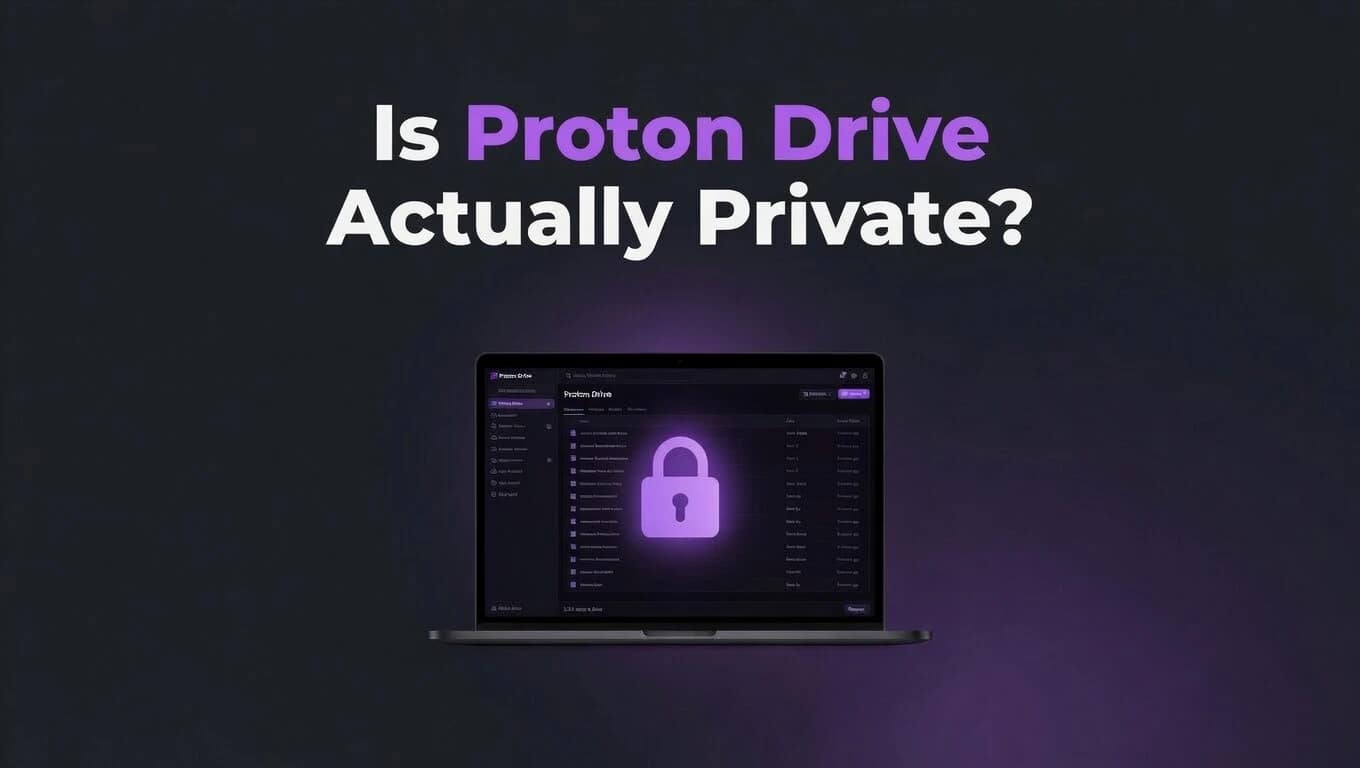
Yes. Proton Drive is genuinely private because your files are encrypted on your device before they ever leave your machine. This uses a cryptographic key derived from your password, meaning not even Proton’s own engineers can view, scan, or access your data. If you are wondering “is Proton Drive actually private,” the short answer is that it represents the gold standard of consumer cloud privacy in 2026.
This page is part of the Proton Drive FAQ Hub.
How does Proton Drive keep my files private?
Proton Drive relies on a concept called zero-knowledge proof architecture. When you drop a file into your Proton Drive folder, the application encrypts the file locally on your computer or phone. Only the scrambled, unreadable ciphertext is sent to Proton’s servers. Because Proton never holds your decryption keys, they possess zero knowledge of what your files contain.
Does Proton Drive scan my files for targeted advertising?
No. Unlike mainstream providers such as Google Drive or Microsoft OneDrive, Proton Drive cannot scan your documents to build an advertising profile. The official Proton Drive security policy explicitly states that the company operates on a subscription business model, not an advertising model. Your data remains completely opaque to them.
Are file names and folder structures also encrypted?
Yes. Some secure cloud storage providers only encrypt the contents of your files, leaving metadata like file names, folder structures, and file sizes visible. Proton Drive encrypts all metadata. If an attacker somehow breached Proton’s servers, they would not even be able to see the names of your folders or the titles of your documents.
Can anyone access my files if I lose my password?
If you lose your password and do not have a recovery phrase saved, your files are permanently locked. Because Proton Drive is actually private, the company has no backdoor access to reset your encryption keys. This is the ultimate proof of privacy. If Proton cannot recover your files for you, they cannot hand them over to anyone else either.
The Fundamental Difference Between Proton Drive and Google Drive
To understand whether Proton Drive is actually private, you have to understand how traditional cloud storage works. When you upload a file to Google Drive, Dropbox, or OneDrive, the connection between your computer and their servers is encrypted. This is known as “encryption in transit.” However, once the file lands on their servers, the company holds the decryption key.
They need this key to scan your files for malware, index your documents for search, and build user profiles. This means their employees, their algorithms, or a government agency with a subpoena can read your data.
Proton Drive turns this model upside down through end-to-end encryption. Your device handles the encryption locally. By the time your tax return, client contract, or personal journal reaches Proton’s servers in Switzerland, it is just a string of mathematically randomized characters. Proton does not hold the key. They physically cannot read your files.
The Privacy Paradox: Why True Privacy Requires Responsibility
One of the hardest lessons for new users migrating to a “Paranoid Productivity” setup is the responsibility that comes with absolute privacy.
Because Proton Drive is actually private, there is no “Forgot Password” button that magically unlocks your encrypted vault. Your password is the foundation of your encryption key. If you forget your password and lose your recovery phrase, your data is gone forever. Proton’s customer support team cannot help you because they cannot bypass the math.
For neurodivergent professionals who struggle with losing passwords, this is a critical factor. You must pair your Proton Drive account with a robust, reliable password manager.
Open Source Code Means You Can Verify the Privacy
Trusting a company that claims to be private is a massive risk. Proton mitigates this risk by making all of its client applications open source.
This means that independent security researchers and software engineers worldwide can look at the exact code running the Proton Drive desktop and mobile apps. They can verify that the encryption is happening exactly as Proton claims it is. If Proton were secretly copying your decryption keys and sending them to a third party, the open-source community would spot it immediately in the code repository. Independent security firms frequently audit this code, publishing their findings to ensure Proton Drive remains as private as advertised.
The BAIZAAR Verdict on Proton Drive Privacy
If you are asking if Proton Drive is actually private, the underlying architecture provides a resounding yes. It removes the need to trust the company holding your data and replaces it with mathematical certainty. If your threat model demands that your external brain systems remain entirely out of reach from corporate data harvesting and government overreach, Proton Drive is the necessary foundation.
Related questions from the FAQ hub
Try Proton Drive Plus: Secure Your Files
Proton Drive Plus gives you 200 GB of zero-knowledge encrypted storage, Proton Docs for private collaboration, and access across all your devices.
Current offer prices at time of writing:
| Plan | 🇬🇧 GBP | 🇺🇸 USD | 🇪🇺 EUR |
|---|---|---|---|
| 1-month intro offer | £0.90/mo (77% off, then £3.99/mo) | $1.00/mo (80% off, then $4.99/mo) | €1.00/mo (80% off, then €4.99/mo) |
| 12-month plan | £1.94/mo (51% off, billed £23.24) | $2.99/mo (40% off, billed $35.92) | €2.99/mo (40% off, billed €35.92) |
Prices shown are correct at time of publishing. Check Proton’s site for the latest.
Proton Drive+
Upgrade to Proton Drive Plus to unlock 200 GB of encrypted cloud storage, advanced file sharing controls, and secure backups across all your devices.
👉 Get BAIZAAR’s Reader Exclusive Discount for Proton Drive Plus here.